July 9, 2026 1 views news
How to Run an Effective Baseball Evaluation Camp
By BabyLoveGrowth.ai
<script type="application/ld+json">
{
"@type": "Article",
"image": {
"url": "https://csuxjmfbwmkxiegfpljm.supabase.co/storage/v1/object/public/blog-images/organization-34605/1783568095973_Coach-reviewing-notes-on-baseball-field.jpeg",
"@type": "ImageObject",
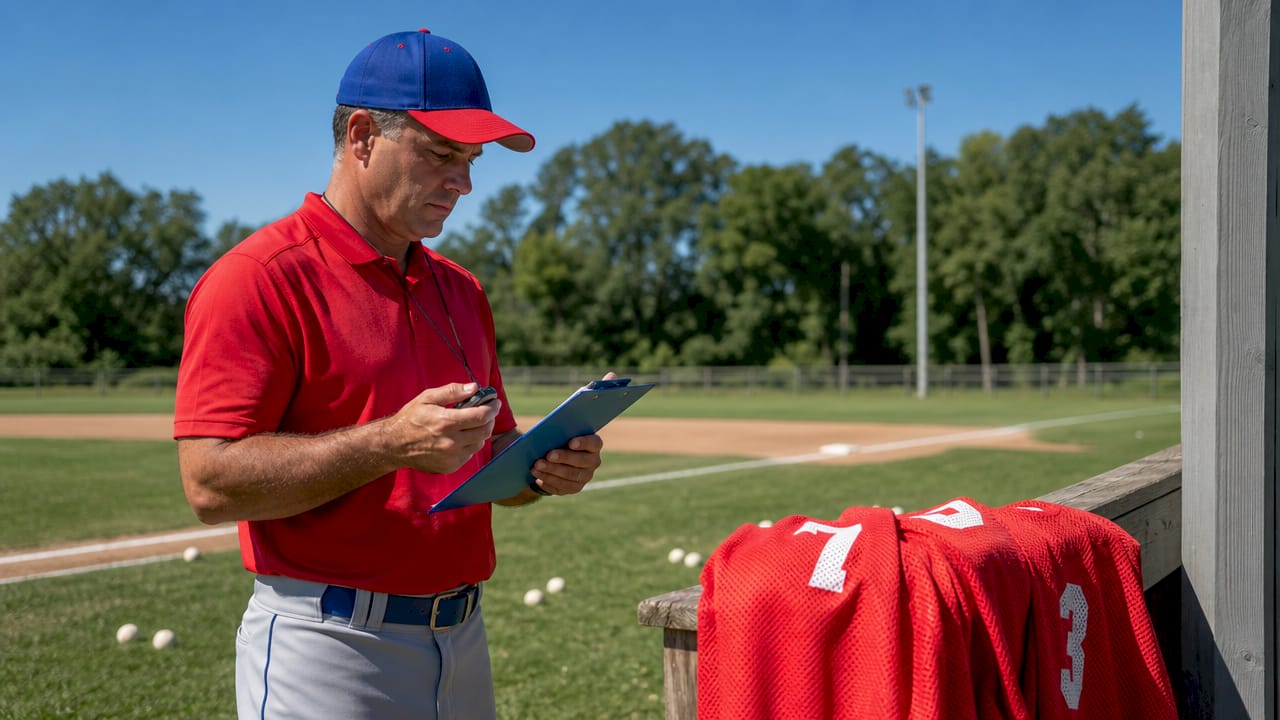
"caption": "Coach reviewing notes on baseball field"
},
"author": {
"url": "https://nationalscoutingbureau.com",
"name": "Nationalscoutingbureau",
"@type": "Organization"
},
"@context": "https://schema.org",
"headline": "How to Run an Effective Baseball Evaluation Camp",
"publisher": {
"url": "https://nationalscoutingbureau.com",
"name": "Nationalscoutingbureau",
"@type": "Organization"
},
"inLanguage": "en-US",
"description": "Discover how to run an effective baseball evaluation camp. Transform subjective impressions into quantifiable data for youth and high school recruitment.",
"datePublished": "2026-07-09T03:37:24.813Z"
}
</script>
<h1 id="how-to-run-an-effective-baseball-evaluation-camp" tabindex="-1">How to Run an Effective Baseball Evaluation Camp</h1>
<p><img src="https://csuxjmfbwmkxiegfpljm.supabase.co/storage/v1/object/public/blog-images/organization-34605/1783568095973_Coach-reviewing-notes-on-baseball-field.jpeg" alt="Coach reviewing notes on baseball field"></p>
<p>A baseball evaluation camp is defined as a structured tryout event that converts subjective impressions into quantifiable player data through a consistent, standardized scoring process. The industry term for this format is a “skills assessment camp,” and it sits at the heart of every serious youth and high school recruitment pipeline. To run an effective baseball evaluation camp, coaches and parents need more than a field and a stopwatch. They need a scoring framework, calibrated evaluators, and a rotation plan that holds up under scrutiny. Nationalscoutingbureau has helped facilitate over 600 college placements, and the foundation of that success starts with exactly this kind of organized, objective evaluation.</p>
<h2 id="what-does-it-take-to-run-an-effective-baseball-evaluation-camp" tabindex="-1">What does it take to run an effective baseball evaluation camp?</h2>
<p>The single most important prerequisite is a <a href="https://nationalscoutingbureau.com/blog/standardized-assessment-tools-for-amateur-baseball-in-2026" target="_blank" rel="noopener">standardized scoring rubric</a> applied consistently across every skill station. A <a href="https://rizzlersports.com/learn/how-to-run-a-baseball-tryout" rel="nofollow noopener noreferrer" target="_blank">1-to-5 scoring rubric</a> across core baseball skills converts subjective observations into quantifiable data for roster decisions. That shift from gut feeling to documented scores is what makes your selections defensible to players, parents, and program stakeholders.</p>
<p>Your evaluation form should cover five core skill categories: hitting, fielding, throwing, running, and intangibles. Each category gets a score from 1 to 5, with brief written notes attached. Speed receives its own objective treatment through timed sprints, which feeds directly into the scoring model.</p>
<p><strong>Staffing and logistics checklist:</strong></p>
<ul>
<li>Recruit at least two evaluators per skill station to cross-check scores</li>
<li>Calibrate all coaches on the rubric before the first player steps on the field</li>
<li>Reserve the facility at least two weeks in advance and confirm field dimensions</li>
<li>Set up a check-in table with pre-printed registration packets</li>
<li>Assign each player a number. Scoring by number rather than name reduces bias, especially at large events with hundreds of participants</li>
<li>Prepare pinnies or numbered bibs, timing devices, and field markers</li>
<li>Print extra evaluation forms. Running out mid-session kills momentum</li>
</ul>
<p><strong>Pro Tip:</strong> <em>Run a 15-minute evaluator calibration session the morning of the camp. Have every coach score the same hypothetical player scenario and compare results. Discrepancies above one point on any skill need to be resolved before the first rotation begins.</em></p>
<table>
<thead>
<tr>
<th>Equipment</th>
<th>Purpose</th>
</tr>
</thead>
<tbody>
<tr>
<td>Numbered pinnies</td>
<td>Anonymous, bias-free scoring by player number</td>
</tr>
<tr>
<td>Stopwatch or radar gun</td>
<td>Objective speed and velocity measurement</td>
</tr>
<tr>
<td>Printed evaluation forms</td>
<td>Consistent data capture across all stations</td>
</tr>
<tr>
<td>Field markers and cones</td>
<td>Clear station boundaries and drill setup</td>
</tr>
<tr>
<td>Clipboard and pens</td>
<td>Immediate score entry after each rep</td>
</tr>
</tbody>
</table>
<h2 id="how-should-the-evaluation-day-flow-for-fair-and-efficient-player-assessment" tabindex="-1">How should the evaluation day flow for fair and efficient player assessment?</h2>
<p>The station rotation model is the backbone of a well-run skills assessment camp. Divide players into small groups of six to eight. Each group rotates through hitting, fielding, throwing, and speed stations on a timed schedule. This keeps the field active, prevents bottlenecks, and gives every evaluator equal time with every player.</p>
<p><strong>Execution steps for the evaluation day:</strong></p>
<ol>
<li><strong>Open with a group warm-up.</strong> A shared warm-up lets evaluators observe movement quality, effort level, and how players interact with teammates before a single drill begins.</li>
<li><strong>Run the 60-yard dash or home-to-first sprint early.</strong> A timed sprint provides objective speed metrics that adjust player scores and removes guesswork from speed comparisons.</li>
<li><strong>Score immediately after each rep.</strong> Evaluators who score right after each rep and attach brief notes produce sharper, more reliable data than those who wait until the end of a station.</li>
<li><strong>Rotate groups every 15–20 minutes.</strong> Tight rotations prevent one station from running long and compressing the schedule for everyone else.</li>
<li><strong>Repeat key stations on day two if possible.</strong> Multi-day evaluations prevent a one-off poor showing from eliminating a talented player. A kid who boots a grounder on day one deserves another look.</li>
<li><strong>Average scores across evaluators at each station.</strong> Multiple evaluators grading the same drill using a shared rubric increases data reliability compared to single-grader assessments. Pool those scores before moving to the next group.</li>
<li><strong>Watch players during transitions and downtime.</strong> Observing players between drills reveals intangibles like hustle, coachability, and team behavior that numeric scores alone cannot capture.</li>
</ol>
<p><strong>Pro Tip:</strong> <em>Designate one coach as the “floater” with no assigned station. Their only job is to observe player behavior during transitions, warm-ups, and water breaks. The intangibles they capture often decide borderline roster spots.</em></p>
<p>The intangibles score is not a soft afterthought. It adjusts the total player score up or down based on documented observations. A player who jogs to the next station, argues with a coach, or checks out during another player’s rep is telling you something real about their character. Document it.</p>
<p><img src="https://csuxjmfbwmkxiegfpljm.supabase.co/storage/v1/object/public/blog-images/organization-34605/1783568240940_Two-coaches-observing-and-scoring-baseball-players.jpeg" alt="Two coaches observing and scoring baseball players"></p>
<h2 id="how-do-you-analyze-evaluation-data-to-make-defensible-roster-decisions" tabindex="-1">How do you analyze evaluation data to make defensible roster decisions?</h2>
<p>Data collection means nothing without a clear process for turning raw scores into final rankings. After the last rotation closes, the real work begins.</p>
<p><strong>Post-camp data process:</strong></p>
<ul>
<li>Collect all evaluation forms and enter scores into a master spreadsheet by player number</li>
<li>Calculate the average score per skill category across all evaluators</li>
<li>Add the intangibles adjustment, positive or negative, to the total</li>
<li>Rank players by total score within each position group</li>
<li>Flag borderline players for a staff discussion before any final decisions are made</li>
</ul>
<p>The staff discussion for borderline players is where your notes earn their keep. A player sitting on the roster bubble with a 3.1 average might have a note that reads “exceptional first-step quickness, needs arm strength work.” That context changes the conversation. Numbers open the door; notes close the deal.</p>
<table>
<thead>
<tr>
<th>Decision tier</th>
<th>Score range</th>
<th>Action</th>
</tr>
</thead>
<tbody>
<tr>
<td>Clear selection</td>
<td>4.0–5.0 average</td>
<td>Offer roster spot promptly</td>
</tr>
<tr>
<td>Strong consideration</td>
<td>3.0–3.9 average</td>
<td>Review notes, confirm position need</td>
</tr>
<tr>
<td>Borderline</td>
<td>2.5–2.9 average</td>
<td>Staff discussion, intangibles review</td>
</tr>
<tr>
<td>Not selected</td>
<td>Below 2.5</td>
<td>Respectful notice with feedback offer</td>
</tr>
</tbody>
</table>
<p><img src="https://csuxjmfbwmkxiegfpljm.supabase.co/storage/v1/object/public/blog-images/organization-34605/1783568158326_Infographic-illustrating-baseball-evaluation-camp-steps.jpeg" alt="Infographic illustrating baseball evaluation camp steps"></p>
<p>Communicating selection outcomes clearly and respectfully protects program reputation and builds trust with players and families. Send decisions within 48 hours of the final evaluation day. Offer a brief feedback call to any player who requests one. That single gesture separates programs that players respect from programs they resent.</p>
<p>Keep all evaluation records for at least two seasons. They give you a baseline for tracking player development and defending selection decisions if a parent challenges the outcome.</p>
<h2 id="what-common-challenges-arise-when-hosting-an-evaluation-camp" tabindex="-1">What common challenges arise when hosting an evaluation camp?</h2>
<p>Even well-planned camps hit friction. Knowing the failure points in advance lets you build solutions before they become problems.</p>
<p><strong>Scoring inconsistency</strong> is the most common issue. Two coaches using the same rubric can still drift apart if they never calibrated. Run that morning calibration session and check in between rotations to catch drift early.</p>
<p><strong>Large player volumes</strong> strain station staffing. If you have more than 60 players, add a parallel station for your highest-traffic drills. Fielding and hitting always draw the longest lines. Staff those stations with three evaluators instead of two.</p>
<p><strong>Player anxiety</strong> shows up as stiff mechanics and uncharacteristic errors. Build a brief “practice rep” into each station before scoring begins. One free swing or one warm-up throw costs you 90 seconds and gives you a truer read on actual ability.</p>
<p><strong>Uncooperative behavior</strong> needs a calm, direct response. Pull the player aside, explain the expectation, and document the interaction on the evaluation form. Do not let one player’s attitude disrupt the rotation for everyone else.</p>
<blockquote>
<p>“The hardest part of hosting a baseball evaluation is not the drills. It is the moment a coach has to tell a kid he did not make the cut. How you handle that moment defines your program’s culture more than any win-loss record ever will. Prepare your communication plan with the same rigor you apply to your station rotation.”</p>
</blockquote>
<p><strong>Weather and logistics backups</strong> need to be in place before camp day. Identify an indoor facility option, have a rain-date communication ready to send, and brief your staff on the contingency plan. A canceled camp with no backup plan costs you player trust and registration fees.</p>
<h2 id="key-takeaways" tabindex="-1">Key Takeaways</h2>
<p>Running an effective baseball evaluation camp requires a standardized rubric, calibrated evaluators, and a structured rotation that turns raw observations into defensible, documented player rankings.</p>
<table>
<thead>
<tr>
<th>Point</th>
<th>Details</th>
</tr>
</thead>
<tbody>
<tr>
<td>Use a 1-to-5 scoring rubric</td>
<td>Apply consistent numeric scores across hitting, fielding, throwing, running, and intangibles at every station.</td>
</tr>
<tr>
<td>Score immediately after each rep</td>
<td>Evaluators who record scores and notes right after each rep produce sharper, more reliable data.</td>
</tr>
<tr>
<td>Run multi-day evaluations</td>
<td>Repeating key stations across two days prevents one poor performance from eliminating a talented player.</td>
</tr>
<tr>
<td>Average scores across evaluators</td>
<td>Pool scores from multiple coaches per station to reduce individual bias and increase data reliability.</td>
</tr>
<tr>
<td>Communicate decisions within 48 hours</td>
<td>Prompt, respectful outcome notices protect program reputation and build long-term trust with families.</td>
</tr>
</tbody>
</table>
<h2 id="what-i-have-learned-from-watching-camps-succeed-and-fail" tabindex="-1">What I have learned from watching camps succeed and fail</h2>
<p>I have watched coaches run camps with nothing but a legal pad and a gut feeling, and I have watched others build spreadsheets so detailed they forgot to actually watch the players. Neither extreme works. The camps that produce the best outcomes sit in the middle: a clear rubric, a disciplined rotation, and evaluators who trust the process enough to let the numbers do the heavy lifting.</p>
<p>The piece most coaches undervalue is the intangibles observation. You can teach a kid to field a ground ball with better footwork. You cannot teach a kid to sprint to first base when he thinks no one is watching. That effort, or the absence of it, tells you more about a player’s ceiling than any single drill ever will. The <a href="https://nationalscoutingbureau.com/blog/how-to-conduct-a-verified-baseball-skills-assessment" target="_blank" rel="noopener">verified baseball skills assessment</a> framework reinforces this point: objective data and character observation work together, not in isolation.</p>
<p>The other thing I have seen derail otherwise solid camps is poor communication after the fact. Coaches spend weeks planning the evaluation and then send a two-line email to cut players. That is a missed opportunity. A brief, honest feedback call turns a disappointed kid into a motivated one who comes back stronger next year. It also turns a frustrated parent into a program advocate. The reputation you build through honest, respectful communication outlasts any single season’s roster.</p>
<blockquote>
<p><em>— Coach</em></p>
</blockquote>
<h2 id="nationalscoutingbureau-tools-for-your-next-evaluation-camp" tabindex="-1">Nationalscoutingbureau tools for your next evaluation camp</h2>
<p>Coaches and parents who want to take their evaluation process to the next level have a proven partner in Nationalscoutingbureau.</p>
<p><img src="https://csuxjmfbwmkxiegfpljm.supabase.co/storage/v1/object/public/blog-images/organization-34605/1780261783187_nationalscoutingbureau.jpg" alt="https://nationalscoutingbureau.com"></p>
<p>Nationalscoutingbureau combines <a href="https://nationalscoutingbureau.com" target="_blank" rel="noopener">verified scouting tools</a> with FlightScope technology to deliver precise performance metrics that college coaches actually trust. The platform supports standardized skill assessment, player tracking, and recruitment visibility across a network that has produced over 600 college placements and more than 20 MLB draft picks. Families also earn up to 12,000 Tuition Rewards points per year, redeemable at over 400 participating colleges. For coaches building a youth baseball evaluation camp with real recruitment stakes, Nationalscoutingbureau brings the structure and the reach to make every assessment count.</p>
<h2 id="faq" tabindex="-1">FAQ</h2>
<h3 id="what-is-a-1-to-5-scoring-rubric-in-baseball-evaluations" tabindex="-1">What is a 1-to-5 scoring rubric in baseball evaluations?</h3>
<p>A 1-to-5 scoring rubric assigns a numeric grade from 1 (well below average) to 5 (elite) for each core skill, converting subjective observations into comparable data. Coaches use these scores to rank players objectively across hitting, fielding, throwing, running, and intangibles.</p>
<h3 id="how-many-evaluators-should-a-baseball-assessment-camp-have-per-station" tabindex="-1">How many evaluators should a baseball assessment camp have per station?</h3>
<p>Each station should have at least two evaluators scoring independently, then averaging their results. Multiple evaluators grading the same drill using a shared rubric increases data reliability compared to single-grader assessments.</p>
<h3 id="why-should-coaches-score-players-by-number-instead-of-by-name" tabindex="-1">Why should coaches score players by number instead of by name?</h3>
<p>Assigning tryout numbers and scoring by number rather than name removes name recognition bias from the process. This practice supports fair scoring, especially at large events where evaluators may know some players personally.</p>
<h3 id="how-long-should-a-youth-baseball-evaluation-camp-last" tabindex="-1">How long should a youth baseball evaluation camp last?</h3>
<p>A single-day camp works for smaller rosters, but multi-day evaluations are the standard for fair talent recognition. Repeating key stations across two days prevents one poor performance from eliminating a player who belongs on the roster.</p>
<h3 id="what-intangibles-should-coaches-observe-during-a-baseball-skills-assessment-camp" tabindex="-1">What intangibles should coaches observe during a baseball skills assessment camp?</h3>
<p>Coaches should document hustle between stations, response to coaching feedback, and behavior during other players’ reps. These observations adjust a player’s total score and often decide borderline roster spots more accurately than drill performance alone.</p>
<h2 id="recommended" tabindex="-1">Recommended</h2>
<ul>
<li><a href="https://nationalscoutingbureau.com/blog/how-to-conduct-a-verified-baseball-skills-assessment" target="_blank" rel="noopener">NSB Scouting | The Nation’s Fastest Growing Scouting Organization</a></li>
<li><a href="https://nationalscoutingbureau.com/blog/benefits-of-verified-performance-assessments-in-baseball" target="_blank" rel="noopener">NSB Scouting | The Nation’s Fastest Growing Scouting Organization</a></li>
<li><a href="https://nationalscoutingbureau.com/blog/how-to-use-technology-for-player-evaluation" target="_blank" rel="noopener">NSB Scouting | The Nation’s Fastest Growing Scouting Organization</a></li>
<li><a href="https://nationalscoutingbureau.com/blog/the-role-of-summer-leagues-in-exposure-for-baseball-recruits" target="_blank" rel="noopener">NSB Scouting | The Nation’s Fastest Growing Scouting Organization</a></li>
</ul>