August 10, 2026 10 views news
How to Improve Your Fielding Range Factor Score
By BabyLoveGrowth.ai
<script type="application/ld+json">
{
"@graph": [
{
"@type": "Article",
"image": {
"url": "https://csuxjmfbwmkxiegfpljm.supabase.co/storage/v1/object/public/blog-images/organization-34605/1786345570731_Baseball-infielder-diving-to-field-ground-ball.jpeg",
"@type": "ImageObject",
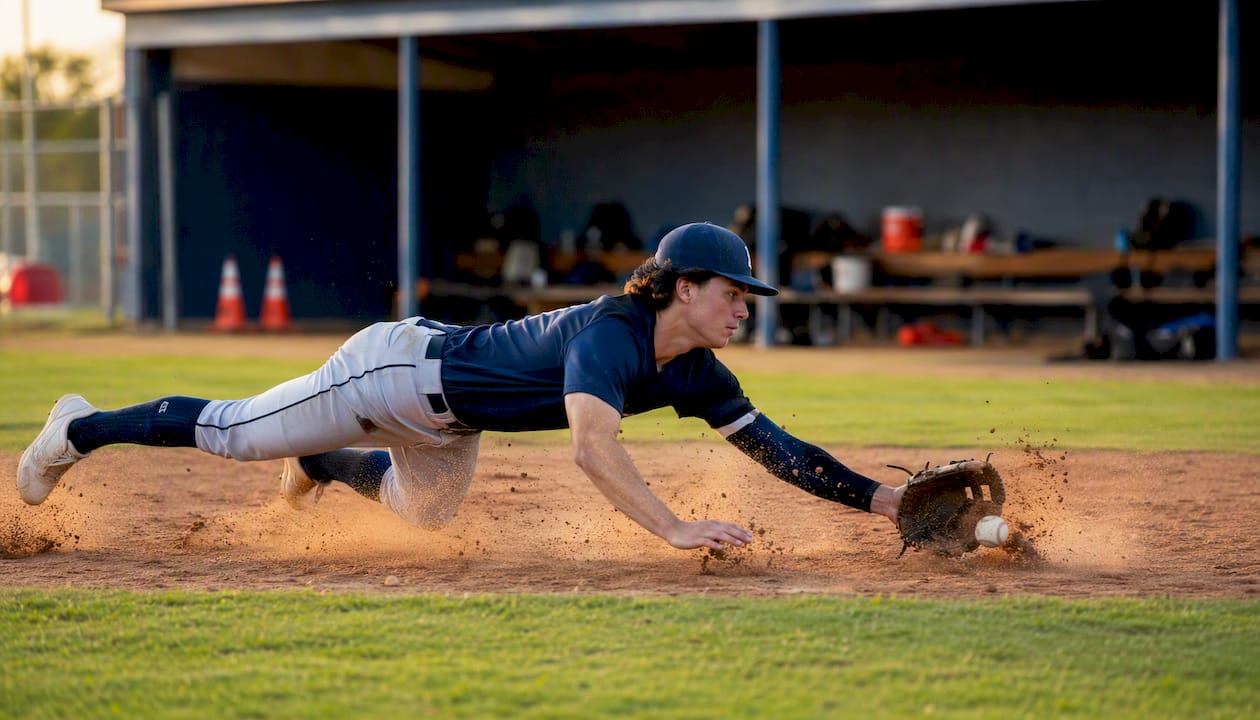
"caption": "Baseball infielder diving to field ground ball"
},
"author": {
"url": "https://nationalscoutingbureau.com",
"name": "Nationalscoutingbureau",
"@type": "Organization"
},
"headline": "How to Improve Your Fielding Range Factor Score",
"publisher": {
"url": "https://nationalscoutingbureau.com",
"name": "Nationalscoutingbureau",
"@type": "Organization"
},
"inLanguage": "en-US",
"description": "Boost your fielding range factor score by optimizing positioning, enhancing your mechanics, and accurately measuring performance. Learn how!",
"dateModified": "2026-08-10T07:16:46.290Z",
"datePublished": "2026-08-10T07:16:46.290Z"
},
{
"@type": "BreadcrumbList",
"itemListElement": [
{
"item": "https://nationalscoutingbureau.com",
"name": "Nationalscoutingbureau",
"@type": "ListItem",
"position": 1
},
{
"item": "https://nationalscoutingbureau.com/improve-fielding-range-factor-score",
"name": "How to Improve Your Fielding Range Factor Score",
"@type": "ListItem",
"position": 2
}
]
}
],
"@context": "https://schema.org"
}
</script>
<h1 id="how-to-improve-your-fielding-range-factor-score" tabindex="-1">How to Improve Your Fielding Range Factor Score</h1>
<p><img src="https://csuxjmfbwmkxiegfpljm.supabase.co/storage/v1/object/public/blog-images/organization-34605/1786345570731_Baseball-infielder-diving-to-field-ground-ball.jpeg" alt="Baseball infielder diving to field ground ball"></p>
<p>Range Factor (RF) measures how many putouts and assists a fielder records per game, calculated as <strong>(Putouts + Assists) / Games played</strong>. Three levers move that number: create more opportunities through smart positioning, convert more plays with elite first-step mechanics and approach angles, and measure accurately using RF/9 instead of raw RF when innings vary.</p>
<p>Here is the formula callout and three things you can act on today:</p>
<p><strong>RF = (PO + A) / G</strong> | <strong>RF/9 = (PO + A) × 9 / IP</strong></p>
<ul>
<li><strong>Opportunity:</strong> Shift your pre-pitch position based on pitcher type and batter tendencies to put yourself in the path of more batted balls.</li>
<li><strong>Conversion:</strong> Drill your first step and approach angle until the correct path is automatic, not reactive.</li>
<li><strong>Measurement:</strong> Log innings, not just games, and use RF/9 to compare players who enter mid-game or sub in late.</li>
</ul>
<hr>
<h2 id="key-takeaways" tabindex="-1">Key Takeaways</h2>
<p>Improving your fielding range factor score requires combining smarter positioning, disciplined first-step mechanics, and consistent RF/9 measurement to turn practice gains into verified, recruitable defensive numbers.</p>
<table>
<thead>
<tr>
<th>Point</th>
<th>Details</th>
</tr>
</thead>
<tbody>
<tr>
<td>Use RF/9, not raw RF</td>
<td>RF/9 normalizes plays to nine innings, making it accurate for substitutes and mixed-role players.</td>
</tr>
<tr>
<td>Drill first step and angles</td>
<td>Backward first steps and curved approach angles are the fastest mechanical levers for expanding range.</td>
</tr>
<tr>
<td>Context shapes every RF</td>
<td>Pitching staff type, shifts, and scorer variation all move RF without reflecting individual skill.</td>
</tr>
<tr>
<td>Compare within position and level</td>
<td>A catcher’s RF near 8.0 and a left fielder’s near 1.9 are structurally different; cross-position comparison is meaningless.</td>
</tr>
<tr>
<td>Nationalscoutingbureau verifies improvement</td>
<td>NSB’s FlightScope metrics and standardized video tagging convert RF gains into documented, recruitable evidence.</td>
</tr>
</tbody>
</table>
<hr>
<h2 id="table-of-contents" tabindex="-1">Table of Contents</h2>
<ul>
<li><a href="#how-you-calculate-range-factor-and-rf9-with-a-worked-example">How you calculate Range Factor and RF/9 (with a worked example)</a></li>
<li><a href="#why-raw-rf-can-mislead-you-without-the-right-context">Why raw RF can mislead you without the right context</a></li>
<li><a href="#position-specific-benchmarks-what-counts-as-a-good-rf-for-your-player">Position-specific benchmarks: what counts as a good RF for your player</a></li>
<li><a href="#drills-that-directly-increase-plays-made-a-progressive-training-plan">Drills that directly increase plays made: a progressive training plan</a></li>
<li><a href="#how-to-measure-progress-reliably-and-build-a-tracking-workflow">How to measure progress reliably and build a tracking workflow</a></li>
<li><a href="#positioning-and-pitcher-tendencies-how-to-create-more-opportunities-the-right-way">Positioning and pitcher tendencies: how to create more opportunities the right way</a></li>
<li><a href="#rf-is-a-signal-not-a-verdict-a-coachs-honest-take">RF is a signal, not a verdict: a coach’s honest take</a></li>
<li><a href="#nationalscoutingbureau-turns-your-rf-gains-into-verified-recruiting-evidence">Nationalscoutingbureau turns your RF gains into verified recruiting evidence</a></li>
<li><a href="#sources">Sources</a></li>
</ul>
<h2 id="how-you-calculate-range-factor-and-rf9-with-a-worked-example" tabindex="-1">How you calculate Range Factor and RF/9 (with a worked example)</h2>
<p>The <a href="https://www.mlb.com/glossary/advanced-stats/range-factor" rel="nofollow noopener noreferrer" target="_blank">MLB Glossary</a> defines two versions of the stat. <strong>RF</strong> divides total defensive plays (putouts plus assists) by games played. <strong>RF/9</strong> multiplies that sum by nine and divides by innings played, which normalizes the count to a full nine-inning game. RF/9 is the better number for any player who enters as a substitute or logs mixed innings across a season.</p>
<p><strong>Worked example for a shortstop:</strong></p>
<ul>
<li>45 games played, 110 innings, 62 putouts, 98 assists</li>
<li><strong>RF</strong> = (62 + 98) / 45 = <strong>3.56</strong></li>
<li><strong>RF/9</strong> = (62 + 98) × 9 / 110 = <strong>13.09</strong></li>
</ul>
<p>The RF/9 figure tells you how many plays that shortstop would be expected to make across a full nine innings, regardless of how many complete games he started. That context matters when you are comparing a starter to a defensive specialist who logs four innings a night.</p>
<p><strong>Where to source the raw counts:</strong></p>
<ul>
<li>Official scorebooks and box scores from your league’s scoring software</li>
<li>Verified scouting reports that apply consistent counting rules across games</li>
<li><a href="https://www.baseball-reference.com/bullpen/Range_factor" rel="nofollow noopener noreferrer" target="_blank">Baseball-Reference</a> for historical and professional-level data</li>
<li>The RF/RF/9 calculator at AthletePath for quick position-specific comparisons</li>
</ul>
<hr>
<h2 id="why-raw-rf-can-mislead-you-without-the-right-context" tabindex="-1">Why raw RF can mislead you without the right context</h2>
<p>RF is simple and public, which is exactly why coaches and scouts must read it carefully. Several systemic factors can inflate or deflate a player’s number with zero connection to individual skill.</p>
<ul>
<li><strong>Pitching staff ground-ball rate.</strong> A ground-ball-heavy staff puts far more balls in play for infielders, inflating their RF while suppressing outfielder totals. A strikeout-heavy staff does the opposite. Baseball-Reference’s RF Bullpen page documents this team-context bias explicitly.</li>
<li><strong>Defensive shifts and positioning.</strong> A second baseman shaded into the right-center gap on a pull-heavy lefty will rack up putouts he would never reach from a standard position. That is positioning, not range.</li>
<li><strong>Official scorer variation.</strong> What one scorer calls a difficult play and records as an assist, another logs as a fielder’s choice. Inconsistent scoring inflates or deflates RF across parks and leagues.</li>
<li><strong>Sample size.</strong> Ten games of RF data is noise. Thirty games starts to signal something real; a full season is where meaningful patterns emerge.</li>
<li><strong>Park and ballpark factors.</strong> Turf fields produce faster grounders and more deflections, which changes how many balls reach fielders in the first place.</li>
</ul>
<p>Pair RF with video-based opportunity tagging, Outs Above Average (OAA), or Ultimate Zone Rating (UZR) to separate what a player earns from what the context hands him. RF is a starting point, not a verdict.</p>
<hr>
<h2 id="position-specific-benchmarks-what-counts-as-a-good-rf-for-your-player" tabindex="-1">Position-specific benchmarks: what counts as a good RF for your player</h2>
<p>RF varies so dramatically by position that comparing a third baseman to a center fielder is meaningless. Catchers and first basemen handle the most plays per game by design; corner outfielders handle the fewest. The AthletePath RF calculator provides position-average benchmarks that reflect these structural differences.</p>
<table>
<thead>
<tr>
<th>Position</th>
<th>Approximate Average RF</th>
<th>What drives the number</th>
</tr>
</thead>
<tbody>
<tr>
<td>Catcher ©</td>
<td>~8.0</td>
<td>High putout volume from strikeouts</td>
</tr>
<tr>
<td>First Base (1B)</td>
<td>~9.2</td>
<td>Receiving throws on nearly every ground ball</td>
</tr>
<tr>
<td>Second Base (2B)</td>
<td>~4.7</td>
<td>High-traffic zone, double-play involvement</td>
</tr>
<tr>
<td>Shortstop (SS)</td>
<td>~4.5</td>
<td>Wide coverage zone, assist-heavy</td>
</tr>
<tr>
<td>Third Base (3B)</td>
<td>~2.7</td>
<td>Fewer chances, reaction-heavy position</td>
</tr>
<tr>
<td>Left Field (LF)</td>
<td>~1.9</td>
<td>Fewest balls in play, limited assist chances</td>
</tr>
<tr>
<td>Center Field (CF)</td>
<td>~2.6</td>
<td>Widest outfield zone, more putout opportunities</td>
</tr>
<tr>
<td>Right Field (RF)</td>
<td>~2.0</td>
<td>Similar to LF with occasional assist chances</td>
</tr>
</tbody>
</table>
<p>A few practical notes on reading these benchmarks:</p>
<ul>
<li>Always compare within position <strong>and</strong> within competitive level. A high school shortstop’s RF against a college shortstop’s benchmark is an apples-to-oranges read.</li>
<li>Season-long RF is the only reliable comparison unit. Mid-season splits can swing wildly based on a hot or cold two-week stretch.</li>
<li>Historical context helps calibrate ambition. Elite defensive shortstops at the professional level have posted RF/9 marks well above position average during peak seasons, but chasing those numbers at the amateur level without accounting for league context is a trap.</li>
</ul>
<hr>
<h2 id="drills-that-directly-increase-plays-made-a-progressive-training-plan" tabindex="-1">Drills that directly increase plays made: a progressive training plan</h2>
<p>Fielding range is trainable. The gap between a player who reaches a ball and one who watches it skip past almost always comes down to three things: pre-pitch reads, first-step mechanics, and approach angles. Here is a drill progression that builds all three.</p>
<h3 id="1-pre-pitch-read-and-creep-drill" tabindex="-1">1. Pre-pitch read and creep drill</h3>
<p>Before every pitch, the fielder identifies the batter’s stance, grip, and likely contact zone. <a href="https://www.abca.org/magazine/magazine/2016-2-Spring/Coaches_Corner_5_Secrets_Top_Infielders_use_to_Increase_their_Range.aspx" rel="nofollow noopener noreferrer" target="_blank">ABCA research</a> confirms that top infielders read the batter’s imaginary strike zone and begin a subtle weight shift toward probable contact before the ball is hit. Practice this in dry reps: call the pitch type, the fielder reads and shifts, coach checks foot position at contact.</p>
<p><img src="https://csuxjmfbwmkxiegfpljm.supabase.co/storage/v1/object/public/blog-images/organization-34605/1786345576360_Infielder-practicing-pre-pitch-weight-shift-drill.jpeg" alt="Infielder practicing pre-pitch weight shift drill"></p>
<h3 id="2-ready-position-and-balance-drill" tabindex="-1">2. Ready-position and balance drill</h3>
<p>Landing weight on the inside balls of the feet, knees slightly bent, hands relaxed in front. <a href="https://baseballtips.com/baseball-infielders-range-and-how-to-improve-it/" rel="nofollow noopener noreferrer" target="_blank">Baseballtips</a> emphasize that an explosive first step is impossible from a flat-footed or heel-heavy stance. Run 10 reps per session where the coach calls “contact” and the fielder explodes laterally from a dead-balanced position.</p>
<h3 id="3-backward-first-step-drill-the-most-overlooked-rep" tabindex="-1">3. Backward first-step drill (the most overlooked rep)</h3>
<p>Most fielders drift forward before contact, which traps them in a low-momentum state when the ball is hit hard or directly at them. <a href="https://coachesinsider.com/baseball/how-to-instantly-improve-your-infield-range/" rel="nofollow noopener noreferrer" target="_blank">Coaches Insider’s infield range guide</a> describes a three-part progression: slow-roll grounders (forward step), hard-hit balls (backward or lateral step), then mixed-speed reps where the fielder must read and choose. The mixed set is where real range improvement happens.</p>
<p><img src="https://csuxjmfbwmkxiegfpljm.supabase.co/storage/v1/object/public/blog-images/organization-34605/1786345617992_Infielder-performing-backward-first-step-on-grounder.jpeg" alt="Infielder performing backward first step on grounder"></p>
<h3 id="4-crossover-step-vs-false-step-practice" tabindex="-1">4. Crossover step vs. false step practice</h3>
<p>A false step (stepping toward the ball before crossing over) costs a fielder 12–18 inches of lateral ground on every play. Drill the crossover exclusively until it is automatic, then reintroduce false-step temptation by mixing ball directions unpredictably.</p>
<h3 id="5-angle-of-approach-drill" tabindex="-1">5. Angle-of-approach drill</h3>
<p>A fielder who runs straight at a ground ball often has to slow down to field it cleanly. The correct approach is a curved arc that puts the fielder’s momentum moving toward the target base. Set cones at the ideal approach angle for backhand and forehand plays; the fielder must hit the cone line on every rep.</p>
<h3 id="6-mixed-speed-live-bp-integration" tabindex="-1">6. Mixed-speed live B.P. integration</h3>
<p>Once mechanics are grooved, move to live batting practice with a mix of soft tosses, hard fungos, and random directions. Track successful plays per session (balls reached and converted to outs) as your leading indicator of RF improvement.</p>
<p><strong>Metrics to track during training:</strong></p>
<ul>
<li>Successful plays per session (reached and converted)</li>
<li>Time-to-ball on video (first frame of contact to fielder’s glove)</li>
<li>Error rate on balls reached (conversion rate, not just range)</li>
</ul>
<p><strong>Pro Tip:</strong> <em>Rehearse backward first steps in a separate block from forward-charging drills. Mixing them in the same set before the pattern is groomed creates interference and slows learning. Separate the movement patterns for at least two weeks, then combine.</em></p>
<hr>
<h2 id="how-to-measure-progress-reliably-and-build-a-tracking-workflow" tabindex="-1">How to measure progress reliably and build a tracking workflow</h2>
<p>Improvement in the gym and on the practice field only counts if it shows up in verified numbers. Here is a step-by-step workflow to convert drill gains into a documented RF/RF/9 increase.</p>
<p><strong>Weekly RF tracking workflow:</strong></p>
<ul>
<li>After each game, pull putouts, assists, and innings from the official scorebook.</li>
<li>Log them in a simple spreadsheet: columns for date, position, PO, A, G, IP, RF, RF/9.</li>
<li>Calculate both RF and RF/9 each week. RF/9 is your primary tracking number if your player’s innings vary.</li>
<li>Flag any game where scorer decisions felt inconsistent and note it in the log.</li>
</ul>
<p><strong>Video review protocol:</strong></p>
<p>Tag every defensive play in three categories: <em>converted</em> (putout or assist recorded), <em>reached but not converted</em> (error or misplay), and <em>not reached</em> (ball in range that was not fielded). The “not reached” category is your RF opportunity gap. Count those plays monthly and watch the number shrink as drills take hold.</p>
<blockquote>
<p>Tracking “not reached” plays on video is more predictive of future RF improvement than the RF number itself. A fielder who reaches more balls but still errors needs conversion work. A fielder who converts cleanly but misses range opportunities needs first-step and read work. The video tags tell you which problem you are actually solving.</p>
</blockquote>
<p>For <a href="https://nationalscoutingbureau.com/blog/standardized-assessment-tools-for-amateur-baseball-in-2026" target="_blank" rel="noopener">standardized assessment tools</a> and scorekeeping protocols that reduce scorer-to-scorer noise, consistent counting rules are the foundation. Without them, week-over-week RF comparisons are unreliable. You can also use <a href="https://nationalscoutingbureau.com/blog/youth-athlete-analytics-platforms-ranked" target="_blank" rel="noopener">youth athlete analytics platforms</a> to centralize data across multiple games and sessions.</p>
<hr>
<h2 id="positioning-and-pitcher-tendencies-how-to-create-more-opportunities-the-right-way" tabindex="-1">Positioning and pitcher tendencies: how to create more opportunities the right way</h2>
<p>More opportunities on the stat sheet should reflect better positioning, not stat-gaming. Here is a pre-game and in-game checklist that raises real RF by putting fielders where the ball actually goes.</p>
<p><strong>Pre-game positioning checklist:</strong></p>
<ul>
<li>Review the pitcher’s ground-ball rate and pitch mix. A sinker-heavy starter means more infield chances; adjust depth accordingly.</li>
<li>Check batter handedness splits. Pull-heavy hitters shift the probability zone toward the pull-side corner.</li>
<li>Study the opposing lineup’s spray charts if available. Even a two-foot shift in starting position can put a fielder on a ball he would otherwise watch go by.</li>
</ul>
<p><strong>In-game adjustments:</strong></p>
<ul>
<li>After each at-bat, reset positioning based on count tendencies. Hitters in two-strike counts make weaker contact and pull less; shade back toward the middle.</li>
<li>Communicate shifts verbally between infielders and through catcher signals so everyone moves together. A shortstop shading pull while the second baseman holds standard creates a gap, not coverage.</li>
</ul>
<p><strong>The creep and balance trade-off:</strong></p>
<p>Creeping a step or two toward probable contact before the pitch is a legitimate range tool, but only when it does not tip the pitcher’s location to the batter. Keep the creep subtle and time it to the pitcher’s wind-up, not the set position.</p>
<p><strong>Pro Tip:</strong> <em>When your team is protecting a lead late in a close game, prioritize team defensive alignment over individual RF. A shortstop who cheats toward his pull-side to pad a putout total and leaves a gap in the middle is hurting the team. RF is a season-long metric; one gap single in a tight game costs far more than one missed putout.</em></p>
<hr>
<h2 id="rf-is-a-signal-not-a-verdict-a-coachs-honest-take" tabindex="-1">RF is a signal, not a verdict: a coach’s honest take</h2>
<p>Range Factor earns its place in any defensive evaluation because it is fast, public, and position-comparable. But I have seen too many recruiting conversations where a player’s RF gets treated as a final grade, stripped of every contextual factor that shaped it. A shortstop on a ground-ball staff in a fast-turf league will post an RF that looks elite next to a player on a strikeout staff in a slow-grass park, even if the second player is the better defender.</p>
<p>The honest use of RF is as a first filter, not a final answer. Pair it with video, with opportunity counts, and with verified metrics like FlightScope movement data, and you get something a college coach can actually trust. That combination is what Nationalscoutingbureau builds into every evaluation: RF and RF/9 as the entry point, standardized video tagging to catch what the box score misses, and FlightScope-derived movement data to confirm what the numbers suggest. One metric alone, no matter how clean the formula, is never enough to evaluate a defender fairly.</p>
<hr>
<h2 id="nationalscoutingbureau-turns-your-rf-gains-into-verified-recruiting-evidence" tabindex="-1">Nationalscoutingbureau turns your RF gains into verified recruiting evidence</h2>
<p>Drilling first steps and tracking RF/9 in a spreadsheet is a strong start. The gap most players hit is that their improvement stays invisible to college coaches because the numbers come from inconsistent scorekeeping and unverified video.</p>
<p><img src="https://csuxjmfbwmkxiegfpljm.supabase.co/storage/v1/object/public/blog-images/organization-34605/1780261783187_nationalscoutingbureau.jpg" alt="Nationalscoutingbureau"></p>
<p>Nationalscoutingbureau closes that gap with a system built for exactly this problem. Verified scouting evaluations apply standardized counting rules across every game, so your RF/9 trend is comparable from week to week. FlightScope technology captures movement metrics that confirm what the putout and assist counts suggest, and video analysis tags missed opportunities alongside converted plays, giving coaches a complete defensive picture. With 600+ college placements and a track record that includes more than 20 MLB draft picks, NSB’s evaluations carry weight in recruiting conversations.</p>
<p>For players and families ready to make defensive improvement visible, explore NSB membership and evaluation options and get your player’s verified defensive report in front of college coaches who are actively recruiting.</p>
<hr>
<h2 id="sources" tabindex="-1">Sources</h2>
<p>These are the primary references behind this guide, each worth bookmarking for ongoing RF work.</p>
<ul>
<li><a href="https://www.mlb.com/glossary/advanced-stats/range-factor" rel="nofollow noopener noreferrer" target="_blank">Range Factor (RF) | Glossary</a></li>
<li><a href="https://www.baseball-reference.com/bullpen/Range_factor" rel="nofollow noopener noreferrer" target="_blank">Range factor - BR Bullpen</a></li>
<li><a href="https://www.abca.org/magazine/magazine/2016-2-Spring/Coaches_Corner_5_Secrets_Top_Infielders_use_to_Increase_their_Range.aspx" rel="nofollow noopener noreferrer" target="_blank">Coaches’ Corner: 5 Secrets Top Infielders use to Increase their Range ABCA Inside Pitch Magazine</a></li>
<li><a href="https://coachesinsider.com/baseball/how-to-instantly-improve-your-infield-range/" rel="nofollow noopener noreferrer" target="_blank">How to Instantly Improve Your Infield Range – Coaches Insider</a></li>
<li><a href="https://baseballtips.com/baseball-infielders-range-and-how-to-improve-it/" rel="nofollow noopener noreferrer" target="_blank">Coaching Baseball Infielders | How To Improve Infield Range</a></li>
</ul>
<h2 id="recommended" tabindex="-1">Recommended</h2>
<ul>
<li><a href="https://nationalscoutingbureau.com/blog/how-to-conduct-a-verified-baseball-skills-assessment" target="_blank" rel="noopener">NSB Scouting | The Nation’s Fastest Growing Scouting Organization</a></li>
<li><a href="https://nationalscoutingbureau.com/blog/how-to-run-an-effective-baseball-evaluation-camp" target="_blank" rel="noopener">NSB Scouting | The Nation’s Fastest Growing Scouting Organization</a></li>
<li><a href="https://nationalscoutingbureau.com/blog/set-measurable-baseball-improvement-goals-in-2026" target="_blank" rel="noopener">NSB Scouting | The Nation’s Fastest Growing Scouting Organization</a></li>
<li><a href="https://nationalscoutingbureau.com/blog/create-standardized-tryout-scoring-rubric" target="_blank" rel="noopener">NSB Scouting | The Nation’s Fastest Growing Scouting Organization</a></li>
</ul>