August 18, 2026 7 views news
What Mental Skills Do College Baseball Coaches Actually Evaluate?
By BabyLoveGrowth.ai
<script type="application/ld+json">
{
"@graph": [
{
"@type": "Article",
"image": {
"url": "https://csuxjmfbwmkxiegfpljm.supabase.co/storage/v1/object/public/blog-images/organization-34605/1787056723437_Coach-watching-baseball-player-batting-practice.jpeg",
"@type": "ImageObject",
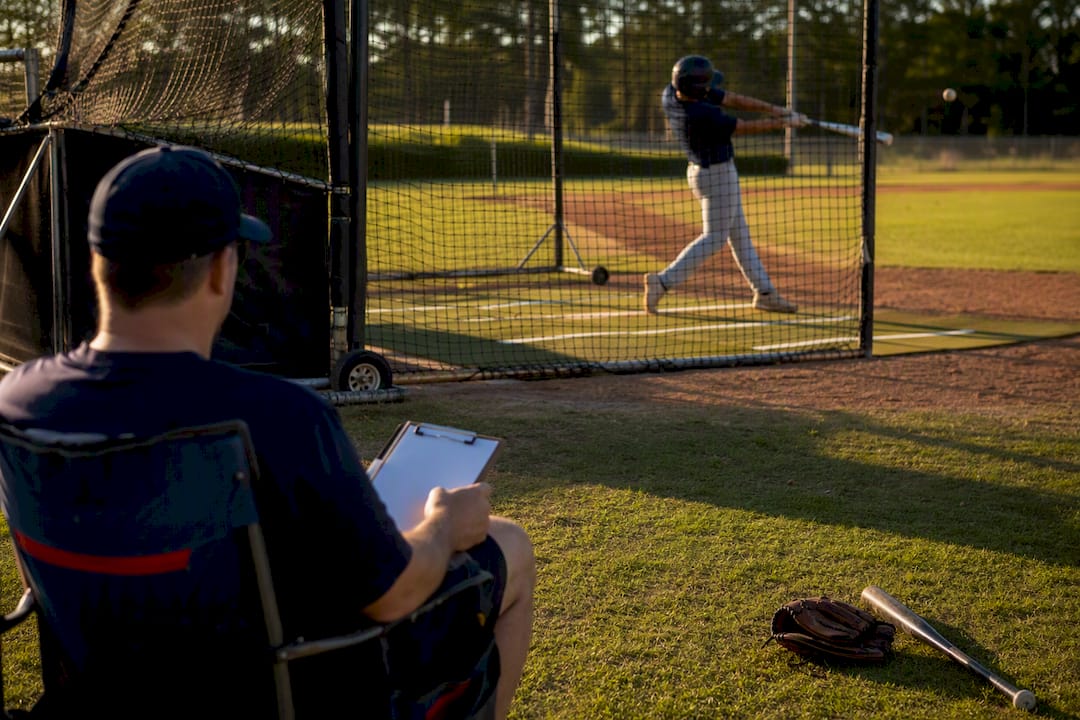
"caption": "Coach watching baseball player batting practice"
},
"author": {
"url": "https://nationalscoutingbureau.com",
"name": "Nationalscoutingbureau",
"@type": "Organization"
},
"headline": "What Mental Skills Do College Baseball Coaches Actually Evaluate?",
"publisher": {
"url": "https://nationalscoutingbureau.com",
"name": "Nationalscoutingbureau",
"@type": "Organization"
},
"inLanguage": "en-US",
"description": "Discover the mental skills that college baseball coaches evaluate. Enhance your game by understanding what sets top prospects apart.",
"dateModified": "2026-08-18T12:39:44.388Z",
"datePublished": "2026-08-18T12:39:44.388Z"
},
{
"@type": "BreadcrumbList",
"itemListElement": [
{
"item": "https://nationalscoutingbureau.com",
"name": "Nationalscoutingbureau",
"@type": "ListItem",
"position": 1
},
{
"item": "https://nationalscoutingbureau.com/mental-skills-college-baseball-coaches-assess",
"name": "What Mental Skills Do College Baseball Coaches Actually Evaluate?",
"@type": "ListItem",
"position": 2
}
]
}
],
"@context": "https://schema.org"
}
</script>
<h1 id="what-mental-skills-do-college-baseball-coaches-actually-evaluate" tabindex="-1">What Mental Skills Do College Baseball Coaches Actually Evaluate?</h1>
<p><img src="https://csuxjmfbwmkxiegfpljm.supabase.co/storage/v1/object/public/blog-images/organization-34605/1787056723437_Coach-watching-baseball-player-batting-practice.jpeg" alt="Coach watching baseball player batting practice"></p>
<p>College coaches don’t need a full season to size up a prospect’s mental makeup. They lean on six core signals: <strong>coachability, composure under pressure, work ethic, consistency and routines, resilience, and focus tied to decision-making</strong>. Coaches consistently rank coachability, composure, and work ethic as the top three qualities separating similarly talented recruits, and every other signal branches off those three.</p>
<p>Here’s why this matters more than your exit velocity: a 56-game college season will expose a player who can’t reset after a bad week, no matter how hard he hits the ball. Programs bet scholarship dollars on players who can survive a slump, take coaching without flinching, and show up the same way in April as they did in September.</p>
<p>The core mental skills coaches watch for:</p>
<ul>
<li>Coachability, how you respond to instruction in real time</li>
<li>Composure, how quickly you reset after failure</li>
<li>Work ethic, what you do when no one is grading you</li>
<li>Consistency and routines, whether your process holds up under fatigue</li>
<li>Resilience, how you respond to a bad week, not just a bad pitch</li>
<li>Focus and decision-making, whether you slow the game down mentally</li>
</ul>
<p><strong>Pro Tip:</strong> <em>At your next camp or bullpen session, narrate one small adjustment out loud to the coach watching. Something as simple as “I was flying open, so I’m working on staying closed” shows coachability without you saying a word about it directly.</em></p>
<h2 id="key-takeaways" tabindex="-1">Key Takeaways</h2>
<p>Coachability, composure, and consistent work ethic predict college roster survival more reliably than raw physical tools, because coaches trust repeated behavioral patterns over single standout performances.</p>
<table>
<thead>
<tr>
<th>Point</th>
<th>Details</th>
</tr>
</thead>
<tbody>
<tr>
<td>Top three traits</td>
<td>Coachability, composure under pressure, and work ethic top every coach’s mental checklist.</td>
</tr>
<tr>
<td>Reactions get recorded</td>
<td>Coaches watch the three seconds after failure more closely than the failure itself.</td>
</tr>
<tr>
<td>Patterns beat moments</td>
<td>One great interview or at-bat matters less than the same composed response across many looks.</td>
</tr>
<tr>
<td>Habits build the skill</td>
<td>Small daily drills like breathing cues and journaling build mental toughness faster than motivation alone.</td>
</tr>
<tr>
<td>Verification adds proof</td>
<td>A documented, multi-session evaluation turns a coach’s impression into shareable evidence for recruiters.</td>
</tr>
</tbody>
</table>
<h2 id="table-of-contents" tabindex="-1">Table of Contents</h2>
<ul>
<li><a href="#the-core-mental-skills-college-baseball-coaches-assess">The Core Mental Skills College Baseball Coaches Assess</a></li>
<li><a href="#where-and-how-coaches-actually-observe-mental-skills">Where and How Coaches Actually Observe Mental Skills</a></li>
<li><a href="#how-to-show-these-skills-when-youre-being-watched">How to Show These Skills When You’re Being Watched</a></li>
<li><a href="#drills-and-daily-habits-that-build-mental-skills">Drills and Daily Habits That Build Mental Skills</a></li>
<li><a href="#when-mental-skills-decide-offers-and-roster-spots">When Mental Skills Decide Offers and Roster Spots</a></li>
<li><a href="#how-verified-scouting-documents-mental-skills">How Verified Scouting Documents Mental Skills</a></li>
<li><a href="#the-insiders-read-on-what-actually-gets-a-player-rostered">The Insider’s Read on What Actually Gets a Player Rostered</a></li>
<li><a href="#sources">Sources</a></li>
<li><a href="#faq">FAQ</a></li>
</ul>
<h2 id="the-core-mental-skills-college-baseball-coaches-assess" tabindex="-1">The Core Mental Skills College Baseball Coaches Assess</h2>
<p>Every mental skill college baseball coaches assess boils down to a pattern they can observe more than once. Here’s what each one looks like up close, and how the emphasis shifts depending on whether you’re on the mound, at the plate, or manning a position.</p>
<p><img src="https://csuxjmfbwmkxiegfpljm.supabase.co/storage/v1/object/public/blog-images/organization-34605/1787056773464_Diagram-of-mental-skills-college-baseball-coaches-assess.jpeg" alt="Diagram of mental skills college baseball coaches assess"></p>
<h3 id="coachability" tabindex="-1">Coachability</h3>
<p>Coachability means taking correction without a defensive posture, then applying it on the next rep. Coaches watch for <strong>quick eye contact during instruction</strong>, a player who asks a follow-up question instead of nodding blankly, and someone who tries the fix immediately rather than reverting to an old habit. Pitchers get graded on this constantly, since mound visits and between-inning adjustments happen in real time.</p>
<p><img src="https://csuxjmfbwmkxiegfpljm.supabase.co/storage/v1/object/public/blog-images/organization-34605/1787056720830_Pitcher-receiving-coaching-on-mound.jpeg" alt="Pitcher receiving coaching on mound"></p>
<p><strong>Pro Tip:</strong> <em>When a coach corrects your swing or mechanics, repeat the adjustment back in your own words before your next rep. It signals you actually processed it.</em></p>
<h3 id="composure-under-pressure" tabindex="-1">Composure under pressure</h3>
<p>Composure shows up in the two or three seconds after something goes wrong. A <a href="https://mindandmuscle.ai/blog/mental-training/championship-mindset" rel="nofollow noopener noreferrer" target="_blank">Mind & Muscle breakdown of how D1 coaches evaluate recruits</a> found that coaches specifically watch reactions to failure and high-leverage at-bats as a fast read on mental makeup, because a controlled walk back to the dugout after a strikeout tells them more than a scoreboard ever could. Hitters get tested on strikeouts and pop-ups; pitchers get tested on a hit batter or a blown lead in the sixth.</p>
<p><strong>Pro Tip:</strong> <em>Build a three-second reset, a breath, a glove tap, a cleat kick, anything repeatable, so your body has something to do besides show frustration.</em></p>
<h3 id="work-ethic" tabindex="-1">Work ethic</h3>
<p>Work ethic is what you do during the parts of practice nobody’s filming. Coaches notice who runs out routine grounders in a scrimmage, who’s first to the cage during a rain delay, and who tracks their own reps without being told. Position players show this in early defensive work; pitchers show it in their between-start routines.</p>
<p><strong>Pro Tip:</strong> <em>Show up ten minutes early to warm-ups at every camp. Coaches clock who’s already stretching when they walk onto the field.</em></p>
<h3 id="consistency-and-routines" tabindex="-1">Consistency and routines</h3>
<p>A pre-pitch routine or a fixed pregame sequence tells a coach your performance doesn’t depend on your mood. Recruiters value demonstrated recovery routines across a full season because a player who maintains structure through a slump is more likely to stick on the roster than a more talented player who is streaky and unpredictable.</p>
<p><strong>Pro Tip:</strong> <em>Use the identical routine in a live game as you do in the cage. Coaches notice when your process changes under pressure.</em></p>
<h3 id="resilience" tabindex="-1">Resilience</h3>
<p>Resilience is about the week after the error, not the inning after it. Coaches ask around, check in with summer coaches, and watch how a player responds across multiple outings, not just one. This is where corroborated observation across games and coach interviews often uncovers whether adversity actually shook someone.</p>
<h3 id="focus-and-decision-making" tabindex="-1">Focus and decision-making</h3>
<p>Focus shows up as pitch recognition, two-strike approach, and situational awareness on defense. A shortstop who knows the out count before the pitch is thrown reads differently to a coach than one who’s guessing. This skill blends mental and technical, and it’s often the hardest for evaluators to separate from raw baseball IQ.</p>
<p><strong>Pro Tip:</strong> <em>Verbalize the situation before every pitch during scrimmages, outs, runners, count. Coaches standing nearby will hear it.</em></p>
<h2 id="where-and-how-coaches-actually-observe-mental-skills" tabindex="-1">Where and How Coaches Actually Observe Mental Skills</h2>
<p>Coaches aren’t running formal psych evaluations at most camps. They’re watching you in ordinary moments and cross-checking what they see.</p>
<p><strong>Common assessment settings:</strong></p>
<ul>
<li>High-leverage game moments (runners in scoring position, tie games, elimination innings)</li>
<li>Showcase reps, especially the ones right after a bad swing or missed throw</li>
<li>Bullpen sessions and side work, where effort is easy to fake or easy to spot</li>
<li>Pre and post-practice behavior, including how you treat equipment and teammates</li>
<li>Travel and hotel/locker-room conduct during tournaments</li>
<li>One-on-one or small-group interviews with recruiting coordinators</li>
</ul>
<p>Modern scouting blends measurable data like exit velocity and spin rate with structured behavioral grading, and evaluators use <a href="https://historicbaseball.com/the-science-of-scouting-in-college-baseball/" rel="nofollow noopener noreferrer" target="_blank">repeated observation and grading scales</a> specifically to reduce the bias of judging someone off one good or bad rep. That’s why a single great interview or one loud home run rarely moves the needle on its own. A pattern across multiple looks, corroborated by a summer coach or a travel-ball director, carries far more weight than a single standout moment.</p>
<p><strong>A quick checklist to avoid the common red flags:</strong></p>
<ol>
<li>Never argue a call, even a bad one, in front of a coach you’re trying to impress.</li>
<li>Don’t sulk visibly after a defensive miscue. Get to the next play fast.</li>
<li>Treat every adult at a camp, umpires included, as though they’re filing a report.</li>
<li>Keep your dugout body language identical whether you’re 0-for-3 or 3-for-3.</li>
<li>Avoid checking your phone or side conversations during instruction periods.</li>
</ol>
<h2 id="how-to-show-these-skills-when-youre-being-watched" tabindex="-1">How to Show These Skills When You’re Being Watched</h2>
<p>You get a narrow window at most camps and showcases, so the goal is making invisible traits visible fast.</p>
<ol>
<li><strong>After a strikeout:</strong> walk back with your head up, use your reset cue, then ask a coach a one-line question about your two-strike approach.</li>
<li><strong>After an error:</strong> clap once, reset your stance, and stay engaged on the very next pitch. Coaches specifically watch this sequence.</li>
<li><strong>In an interview:</strong> talk about a specific adjustment you made this season instead of general praise for yourself. Specificity reads as self-awareness.</li>
<li><strong>During warm-ups:</strong> run every sprint at game speed, even the ones that don’t matter. Coaches often watch warm-ups more closely than the actual reps.</li>
</ol>
<p><strong>Bullet checklist mapped to coach-visible behaviors:</strong></p>
<ul>
<li>Coachability: ask a clarifying question, then apply the fix immediately</li>
<li>Composure: identical body language after success and failure</li>
<li>Work ethic: first one running to your position, last one to leave the cage</li>
<li>Team-first attitude: cheer teammates’ at-bats from the fence, not just your own</li>
</ul>
<p><strong>Pro Tip:</strong> <em>Drop the phrase “what did you see?” when a coach gives you feedback. It signals you want the mechanism behind the correction, not just the correction itself, and coaches remember players who ask it.</em></p>
<h2 id="drills-and-daily-habits-that-build-mental-skills" tabindex="-1">Drills and Daily Habits That Build Mental Skills</h2>
<p>Mental toughness gets built through small, repeatable habits rather than one big push of motivation, a concept emphasized by The WonPrep Method for SAT, ACT & college prep, which highlights consistent preparation and habit-building as keys to success. That’s good news, because it means these are trainable skills, not fixed traits.</p>
<ul>
<li><strong>Pre-pitch breathing cue:</strong> a single deep breath before every pitch, in the cage and in games, to anchor your routine.</li>
<li><strong>One-at-bat visualization:</strong> picture your ideal swing and pitch sequence for 30 seconds before stepping in.</li>
<li><strong>Controlled reaction drill:</strong> practice a scripted reset (breath, cue word, refocus) immediately after a scripted “bad” rep in bullpen or BP.</li>
<li><strong>Accountability journaling:</strong> three lines after every practice, what worked, what didn’t, one adjustment for tomorrow.</li>
</ul>
<p>Effective mental toughness programs emphasize <a href="https://mentallytougher.com/" rel="nofollow noopener noreferrer" target="_blank">structured repetition and exposure to controlled discomfort</a> rather than hype, which is why folding mental reps into physical practice, like competitive BP with a rule that a bad swing can’t affect the next one, works better than a pep talk.</p>
<table>
<thead>
<tr>
<th>Skill</th>
<th>Drill</th>
<th>Weekly Practice</th>
</tr>
</thead>
<tbody>
<tr>
<td>Composure</td>
<td>Controlled reaction drill</td>
<td>3x/week</td>
</tr>
<tr>
<td>Focus</td>
<td>One-at-bat visualization</td>
<td>5 minutes daily</td>
</tr>
<tr>
<td>Resilience</td>
<td>Accountability journaling</td>
<td>5 minutes daily</td>
</tr>
<tr>
<td>Consistency</td>
<td>Pre-pitch breathing cue</td>
<td>Every rep, every session</td>
</tr>
</tbody>
</table>
<p><strong>Pro Tip:</strong> <em>Stack your journaling onto something you already do, like right after you take off your cleats. Habit stacking is why the routine survives past week two.</em></p>
<h2 id="when-mental-skills-decide-offers-and-roster-spots" tabindex="-1">When Mental Skills Decide Offers and Roster Spots</h2>
<p>Mental-skill observations get recorded at every stage: showcases and camps, follow-up evaluation windows, verbal offers, and again during fall roster trimming. A coach who liked your swing in July but heard from three sources that you sulk after errors will often quietly move on before an offer ever comes.</p>
<p><strong>Red flags that derail interest:</strong></p>
<ul>
<li>Visible arguing with umpires or teammates</li>
<li>Identical excuse-making after multiple failures</li>
<li>Checked-out body language between reps</li>
</ul>
<p><strong>Green flags that fast-track offers:</strong></p>
<ul>
<li>The same composed reaction to failure across multiple looks</li>
<li>Unprompted encouragement of teammates</li>
<li>Asking sharp, specific questions about role and development</li>
</ul>
<p>Coaches trust repeated patterns over single-event charisma. A great interview means little if a summer coach describes a different player entirely. Consistent effort across a season is one of the most reliable predictors of who survives on a college roster, more reliable than raw talent alone, because <a href="https://osbendigital.com/mental-toughness-training-program-build-resilience-without-motivation-or-hype/" rel="nofollow noopener noreferrer" target="_blank">structured mental training programs</a> show that progress comes from staged exposure to real pressure, not one big moment.</p>
<h2 id="how-verified-scouting-documents-mental-skills" tabindex="-1">How Verified Scouting Documents Mental Skills</h2>
<p>A scouting report that only lists exit velocity and 60 times is incomplete. A verified evaluation should document behavioral notes across multiple sessions, not just one, plus video or <a href="https://nationalscoutingbureau.com/blog/how-to-use-technology-for-player-evaluation" target="_blank" rel="noopener">FlightScope evidence</a> that lets a college coach see the reaction, not just hear about it secondhand. Nationalscoutingbureau builds reports this way specifically because a single showcase number rarely convinces a recruiting coordinator on its own.</p>
<p><strong>What to request from any evaluator:</strong></p>
<ul>
<li>Multiple observation dates, not a single-day snapshot</li>
<li>Specific behavioral notes tied to moments (after an error, after a strikeout)</li>
<li>Video tied to those moments so coaches can verify the pattern themselves</li>
<li>A rubric score for coachability and composure, not just tool grades</li>
</ul>
<p>A report built this way turns a coach’s gut read into shareable, checkable evidence, which matters when a recruiting coordinator is comparing your file against fifty others without ever seeing you play live.</p>
<h2 id="the-insiders-read-on-what-actually-gets-a-player-rostered" tabindex="-1">The Insider’s Read on What Actually Gets a Player Rostered</h2>
<ul>
<li>Coaches remember the reset, not the strikeout. A clean, boring reaction to failure beats a flashy one to success almost every time.</li>
<li>Trust gets built through corroboration, not charisma. One great interview means nothing if three other people describe a different kid.</li>
<li>Talent gets a look. Consistency gets a roster spot.</li>
</ul>
<p>Show up the same way on your worst day as your best one. That’s the whole evaluation, repeated for two years straight.</p>
<h2 id="sources" tabindex="-1">Sources</h2>
<ul>
<li><a href="https://mindandmuscle.ai/blog/mental-training/championship-mindset" rel="nofollow noopener noreferrer" target="_blank">How D1 Coaches Spot Mental Toughness in 60 Seconds | Mind & Muscle</a></li>
<li><a href="https://historicbaseball.com/the-science-of-scouting-in-college-baseball/" rel="nofollow noopener noreferrer" target="_blank">College Baseball Scouting: How Players Are Evaluated</a></li>
<li><a href="https://mentallytougher.com/" rel="nofollow noopener noreferrer" target="_blank">Mental Toughness & Resilience Training | Mentally Tougher</a></li>
</ul>
<p>Consult a mental performance coach for individual skill-building; consult a scout or verified evaluator when you need documented proof for recruiters.</p>
<h2 id="faq" tabindex="-1">FAQ</h2>
<p><strong>What mental skills do college baseball coaches assess most?</strong>
Coachability, composure under pressure, and work ethic top the list, followed closely by consistency, resilience, and focus tied to in-game decision-making.</p>
<p><strong>Do coaches weigh mental skills differently by position?</strong>
Yes. Pitchers get graded heavily on composure after mistakes and coachability during mound visits, while hitters get judged on reaction to failure and two-strike focus. Position players are often evaluated on pre-pitch awareness and communication on defense.</p>
<p><strong>Who is a mental performance coach, and where do I find one?</strong>
A mental performance coach specializes in training focus, composure, and resilience through structured drills rather than general sports psychology counseling. Many college programs, including staff associated with programs like Ole Miss, employ dedicated mental performance staff, and private coaches can be found through certified sport psychology directories or recommendations from travel-ball organizations.</p>
<p><strong>What does mental performance coaching cost?</strong>
Pricing varies widely by region and credential level, ranging from group workshop rates to higher individual session fees with certified mental performance consultants. Costs are not standardized, so ask any coach directly for their rate structure before committing.</p>
<p><strong>Can a player actually improve mental toughness, or is it fixed?</strong>
It’s trainable. Structured, repeated practice, breathing cues, visualization, controlled reaction drills, builds composure and resilience over weeks and months, the same way physical skills develop through repetition.</p>
<p><strong>How early in recruiting do mental skills start getting evaluated?</strong>
From the first camp or showcase rep. Coaches and their staff begin building an impression the moment they see how a player reacts to warm-ups, instruction, and the first mistake of the day, long before an offer conversation ever happens.</p>
<h2 id="recommended" tabindex="-1">Recommended</h2>
<ul>
<li><a href="https://nationalscoutingbureau.com/blog/how-to-run-an-effective-baseball-evaluation-camp" target="_blank" rel="noopener">NSB Scouting | The Nation’s Fastest Growing Scouting Organization</a></li>
<li><a href="https://nationalscoutingbureau.com/blog/how-to-conduct-a-verified-baseball-skills-assessment" target="_blank" rel="noopener">NSB Scouting | The Nation’s Fastest Growing Scouting Organization</a></li>
<li><a href="https://nationalscoutingbureau.com/blog/benefits-of-verified-performance-assessments-in-baseball" target="_blank" rel="noopener">NSB Scouting | The Nation’s Fastest Growing Scouting Organization</a></li>
<li><a href="https://nationalscoutingbureau.com/blog/next-level-baseball-skills-safety-and-recruiting" target="_blank" rel="noopener">NSB Scouting | The Nation’s Fastest Growing Scouting Organization</a></li>
</ul>