June 12, 2026 13 views news
Role of Biomechanics in Youth Sports: 2026 Guide
By BabyLoveGrowth.ai
<script type="application/ld+json">
{
"@type": "Article",
"image": {
"url": "https://csuxjmfbwmkxiegfpljm.supabase.co/storage/v1/object/public/blog-images/organization-34605/1781260157846_Youth-athlete-landing-monitored-during-biomechanics-assessment.jpeg",
"@type": "ImageObject",
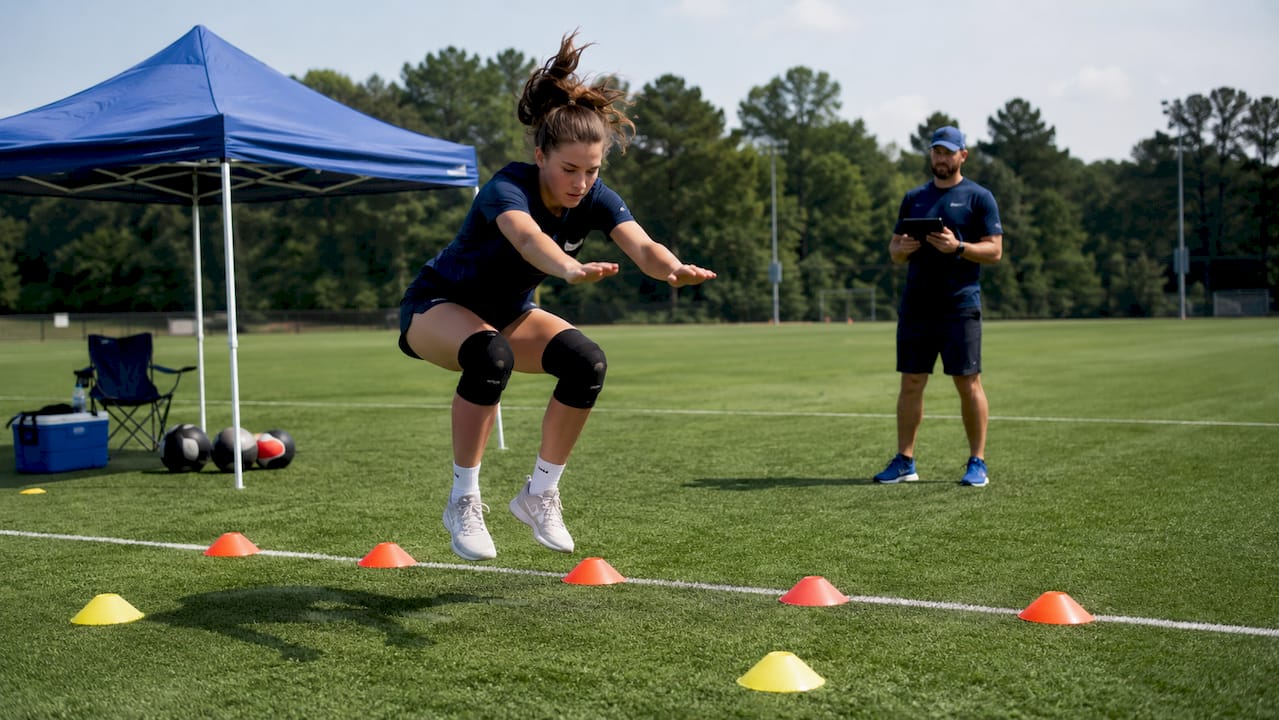
"caption": "Youth athlete landing monitored during biomechanics assessment"
},
"author": {
"url": "https://nationalscoutingbureau.com",
"name": "Nationalscoutingbureau",
"@type": "Organization"
},
"@context": "https://schema.org",
"headline": "Role of Biomechanics in Youth Sports: 2026 Guide",
"publisher": {
"url": "https://nationalscoutingbureau.com",
"name": "Nationalscoutingbureau",
"@type": "Organization"
},
"inLanguage": "en-US",
"description": "Discover the vital role of biomechanics in youth sports. Enhance performance, reduce injuries, and support young athletes' development with our 2026 guide.",
"datePublished": "2026-06-12T10:35:35.599Z"
}
</script>
<h1 id="role-of-biomechanics-in-youth-sports-2026-guide" tabindex="-1">Role of Biomechanics in Youth Sports: 2026 Guide</h1>
<p><img src="https://csuxjmfbwmkxiegfpljm.supabase.co/storage/v1/object/public/blog-images/organization-34605/1781260157846_Youth-athlete-landing-monitored-during-biomechanics-assessment.jpeg" alt="Youth athlete landing monitored during biomechanics assessment"></p>
<p>Biomechanics in youth sports is the scientific study of human movement forces that directly shapes athletic performance, reduces injury risk, and sharpens a young athlete’s recruitment profile. The role of biomechanics in youth sports goes far beyond watching a kid run faster or throw harder. It means understanding <em>why</em> a landing is dangerous, <em>how</em> a faulty arm swing bleeds energy, and <em>when</em> to intervene during a growth spurt before bad habits cement themselves. For parents and coaches, this science is the difference between an athlete who peaks early and burns out versus one who develops steadily and earns a college scholarship.</p>
<h2 id="how-does-biomechanics-improve-performance-and-reduce-injury-risk" tabindex="-1">How does biomechanics improve performance and reduce injury risk?</h2>
<p>Biomechanics training for kids works by identifying movement faults before they become injuries or performance ceilings. The most common culprits coaches overlook are excessive heel striking during sprints, knee valgus on landings, and arm crossover during straight-line running. Each of these wastes energy and loads joints incorrectly. Fix them early, and you get a faster, more durable athlete.</p>
<p><a href="https://www.frontiersin.org/journals/public-health/articles/10.3389/fpubh.2026.1801019/full" rel="nofollow noopener noreferrer" target="_blank">Neuromuscular training programs</a> targeting lower-extremity biomechanics and core control significantly reduce ACL injury risk in young adolescent athletes. Meta-analyses from 2026 confirm the highest preventive benefits appear in younger adolescents, where neuroplasticity gives coaches a real edge. That means a 12-year-old responds to corrective training faster and more completely than a 17-year-old with years of ingrained compensation patterns.</p>
<p>Proprioception exercises and core control drills are the unsung heroes of youth sports injury prevention. When a young athlete can feel where their knee tracks during a cut, they self-correct in real time. That automatic adjustment is what separates athletes who stay healthy through a full season from those who limp off the field in week three.</p>
<ul>
<li><strong>Heel strike correction</strong> during sprinting reduces quad and shin stress while improving stride efficiency</li>
<li><strong>Knee valgus retraining</strong> on jump landings is the single most effective ACL prevention technique available</li>
<li><strong>Arm swing mechanics</strong> directly affect running economy; crossover patterns waste lateral energy on every stride</li>
<li><strong>Core bracing patterns</strong> protect the lumbar spine during rotational sports like baseball, tennis, and lacrosse</li>
</ul>
<p><strong>Pro Tip:</strong> <em>Watch your athlete land from a box jump. If their knees cave inward even slightly, that pattern shows up in every sprint, cut, and jump they take in competition. Address it in training before it becomes a torn ligament in a game.</em></p>
<h2 id="what-are-common-methods-used-to-assess-biomechanics-in-youth-sports" tabindex="-1">What are common methods used to assess biomechanics in youth sports?</h2>
<p>Youth sports performance analysis starts with choosing the right assessment tool for the athlete’s age, sport, and development stage. No single method covers everything. The best programs combine two or three approaches to build a complete picture.</p>
<p><img src="https://csuxjmfbwmkxiegfpljm.supabase.co/storage/v1/object/public/blog-images/organization-34605/1781260277115_Overhead-of-youth-in-motion-capture-lab-with-technician.jpeg" alt="Overhead of youth in motion capture lab with technician"></p>
<p><a href="https://www.nationwidechildrens.org/specialties/sports-medicine/sports-medicine-services/biomechanical-video-analysis" rel="nofollow noopener noreferrer" target="_blank">Biomechanical video analysis</a> involves frame-by-frame movement assessment to identify mechanical deviations and prescribe corrective drills. Centers like Nationwide Children’s Hospital use this process to record athletes, have specialists analyze the footage, and then build tailored training plans. The transparency is a major advantage. Athletes, coaches, and parents all see the same footage and understand exactly what needs to change.</p>
<p>Motion capture systems and wearable sensors push the analysis deeper. Tools like force plates measure ground reaction forces during landings, while inertial measurement units track joint angles in real time during sport-specific movements. These technologies are increasingly available at high school and club levels, not just elite programs.</p>
<p><img src="https://csuxjmfbwmkxiegfpljm.supabase.co/storage/v1/object/public/blog-images/organization-34605/1781260533260_Infographic-showing-biomechanics-assessment-steps-in-youth-sports.jpeg" alt="Infographic showing biomechanics assessment steps in youth sports"></p>
<p>Age matters enormously in assessment design. A 9-year-old needs a simple movement screen, not a full gait lab workup. A 15-year-old mid-growth spurt needs maturation-based screening rather than age-based norms. <a href="https://rsdjournal.org/rsd/article/view/50542" rel="nofollow noopener noreferrer" target="_blank">Biomechanical screenings interpreted by maturation stage</a> rather than chronological age produce more effective training plans and avoid mismatched approaches that can actually cause harm.</p>
<table>
<thead>
<tr>
<th>Assessment Method</th>
<th>Best Context</th>
<th>Key Advantage</th>
</tr>
</thead>
<tbody>
<tr>
<td>Video analysis</td>
<td>All ages, in-field or clinic</td>
<td>Visual feedback for athletes, parents, and coaches</td>
</tr>
<tr>
<td>Motion capture</td>
<td>Post-growth spurt, performance focus</td>
<td>Precise joint angle and force data</td>
</tr>
<tr>
<td>Wearable sensors</td>
<td>In-season monitoring</td>
<td>Real-time data during actual sport activity</td>
</tr>
<tr>
<td>Clinical movement screen</td>
<td>Ages 6–14, early intervention</td>
<td>Low cost, identifies gross movement faults quickly</td>
</tr>
<tr>
<td>Force plate testing</td>
<td>Strength and power assessment</td>
<td>Quantifies landing mechanics and asymmetries</td>
</tr>
</tbody>
</table>
<p><strong>Pro Tip:</strong> <em>Ask any biomechanics program whether they assess by maturation stage or just by age. If they only use age, find a different program. A 13-year-old who is pre-growth spurt and one who is post-peak height velocity need completely different training plans.</em></p>
<h2 id="how-do-biomechanical-training-programs-adapt-to-development-stages" tabindex="-1">How do biomechanical training programs adapt to development stages?</h2>
<p>Biomechanical principles in athletics demand that training programs match where an athlete actually is in their physical development, not where their birth certificate says they should be. The three phases of youth development each require a different focus.</p>
<ol>
<li>
<p><strong>Ages 6–10 (pre-growth spurt):</strong> This is the golden window. <a href="https://www.functionalpatternsbrisbane.com/conditions/kids-teens" rel="nofollow noopener noreferrer" target="_blank">Starting biomechanical assessments between ages 6 and 10</a> enables early correction of poor movement habits with the highest success rates. The nervous system is highly receptive, and movement patterns laid down here become the foundation for everything that follows. Focus on gait mechanics, basic landing patterns, and throwing mechanics in sport-specific contexts.</p>
</li>
<li>
<p><strong>Ages 11–14 (during the growth spurt):</strong> This phase is tricky. <a href="https://ciss-journal.org/article/view/13317" rel="nofollow noopener noreferrer" target="_blank">Limb elongation and a rising center of mass</a> temporarily impair motor control, creating what researchers call “adolescent awkwardness.” Injury risk spikes here. The goal is not to push performance but to retrain motor patterns that the growth spurt has disrupted. Neuromuscular stability work takes priority over speed or strength gains.</p>
</li>
<li>
<p><strong>Ages 15 and older (post-peak height velocity):</strong> The athlete’s body has stabilized. Now you can layer sport-specific technical training on top of the movement foundation built in earlier phases. Athletes who skipped phases one and two often arrive here with deeply ingrained compensation patterns that are genuinely hard to fix.</p>
</li>
</ol>
<p>The “mechanics before load” principle governs all three phases. <a href="https://runspeedperformance.com/youth-speed-development/" rel="nofollow noopener noreferrer" target="_blank">Simple bodyweight movements</a> provide the best biomechanical foundation before adding resistance or complexity. Mastering a bodyweight squat before loading a barbell is not just caution. It is the most direct path to long-term functional movement quality. Coaches who rush to load young athletes are building on sand.</p>
<p><strong>Pro Tip:</strong> <em>If your athlete is going through a growth spurt and suddenly looks clumsy or is picking up minor injuries, do not push harder. Pull back on intensity, add neuromuscular stability work, and let the nervous system catch up to the new body. This phase passes. Injuries from ignoring it do not.</em></p>
<h2 id="in-what-ways-does-biomechanics-training-impact-recruitment" tabindex="-1">In what ways does biomechanics training impact recruitment?</h2>
<p>The impact of biomechanics on youth athletes extends directly into the recruitment process. College coaches and scouts are not just watching what an athlete does. They are watching <em>how</em> they do it. Movement efficiency signals coachability, durability, and long-term upside. An athlete who moves cleanly stands out on film even when their raw stats are similar to competitors.</p>
<p>Biomechanics coaching focused on movement efficiency corrects faults like excessive heel strikes and arm crossover, enhancing speed and reducing energy expenditure. That translates directly into better combine numbers, stronger game film, and a body that holds up through a college season. Recruiters at the Division I level have seen enough broken-down athletes to value durability as much as raw talent.</p>
<p>Biomechanical video analysis also serves as a transparent tool for showcasing athlete potential. When a family can provide a college coach with documented movement quality data alongside traditional stats, it tells a story most recruiting profiles never tell. It says: this athlete has been developed intentionally, and here is the proof.</p>
<ul>
<li><strong>Clean movement patterns</strong> on film signal to recruiters that an athlete is coachable and has been properly developed</li>
<li><strong>Documented biomechanical progress</strong> gives college coaches confidence in an athlete’s long-term trajectory</li>
<li><strong>Injury-free track records</strong> built through proper mechanics training make athletes far more attractive to programs with limited scholarship budgets</li>
<li><strong>Technical mastery</strong> in sport-specific movements, like a pitcher’s arm path or a sprinter’s drive phase, differentiates athletes at elite showcases</li>
</ul>
<p>Preventing early fixation of compensation patterns is equally critical. Athletes who develop workarounds for poor mechanics early often hit a ceiling in high school that no amount of extra practice can break through. The foundation of biomechanics before sport-specific training avoids that ceiling entirely by building correct patterns from the start.</p>
<p>You can explore how <a href="https://nationalscoutingbureau.com/blog/technology-tools-for-youth-athlete-assessment-in-2026" target="_blank" rel="noopener">athlete assessment tools</a> are evolving in 2026 to give young athletes a measurable edge in the recruiting process.</p>
<h2 id="key-takeaways" tabindex="-1">Key takeaways</h2>
<p>Biomechanics training works best when it starts early, matches the athlete’s maturation stage, and prioritizes movement quality over training load at every phase of development.</p>
<table>
<thead>
<tr>
<th>Point</th>
<th>Details</th>
</tr>
</thead>
<tbody>
<tr>
<td>Start assessments early</td>
<td>Ages 6–10 offer the highest success rates for correcting movement faults before they become permanent.</td>
</tr>
<tr>
<td>Match training to maturation</td>
<td>Assess by peak height velocity stage, not chronological age, for safe and effective programming.</td>
</tr>
<tr>
<td>Mechanics before load</td>
<td>Master bodyweight movement patterns before adding resistance to build durable, efficient athletes.</td>
</tr>
<tr>
<td>Video analysis builds recruitment profiles</td>
<td>Documented movement quality data gives college coaches evidence of intentional athlete development.</td>
</tr>
<tr>
<td>Neuromuscular training prevents ACL injuries</td>
<td>NMT programs targeting lower-extremity biomechanics show the strongest preventive results in younger adolescents.</td>
</tr>
</tbody>
</table>
<h2 id="what-ive-learned-watching-biomechanics-transform-young-athletes" tabindex="-1">What i’ve learned watching biomechanics transform young athletes</h2>
<p>I have watched parents pour money into private hitting lessons, speed camps, and showcase tournaments while their kid’s landing mechanics quietly set up a knee injury that wipes out a full season. The hard truth is that sport-specific skill work built on a broken movement foundation does not stick. It just makes the compensation pattern faster and stronger.</p>
<p>The programs that produce durable, recruited athletes share one trait: they treat movement quality as the non-negotiable foundation, not an afterthought. They screen athletes by maturation stage, not just age. They use <a href="https://astor.edu.sg/post/importance-of-active-movement-in-schools" rel="nofollow noopener noreferrer" target="_blank">active movement development</a> as a daily priority, not a once-a-year physical. And they have the patience to let a kid look “slower” for six months while the nervous system rebuilds correctly, knowing the payoff comes when it counts.</p>
<p>The growth spurt phase is where I see the most mistakes. Coaches push harder because the athlete looks bigger and stronger. But the nervous system has not caught up yet. That is when you get the stress fractures, the ACL tears, the shoulder impingements. Patience during that window is not weakness. It is the smartest investment you can make in a young athlete’s career.</p>
<p>If you are a parent or coach reading this, ask your program one question: how do you adjust training during a growth spurt? The answer will tell you everything you need to know about whether they understand biomechanics or just talk about it.</p>
<blockquote>
<p><em>— Coach</em></p>
</blockquote>
<h2 id="how-nationalscoutingbureau-supports-your-athletes-development" tabindex="-1">How Nationalscoutingbureau supports your athlete’s development</h2>
<p>Nationalscoutingbureau combines verified scouting with performance metrics that go beyond traditional stats. Using FlightScope technology, NSB captures the kind of precise movement and output data that college coaches actually want to see. That means your athlete’s biomechanical development does not just stay in the training facility. It shows up in their recruiting profile where it matters most.</p>
<p><img src="https://csuxjmfbwmkxiegfpljm.supabase.co/storage/v1/object/public/blog-images/organization-34605/1780261783187_nationalscoutingbureau.jpg" alt="https://nationalscoutingbureau.com"></p>
<p>With a track record of 600+ college placements and more than 20 MLB draft picks, Nationalscoutingbureau knows what recruiters look for and how to present athletes in the best possible light. Families also earn up to 12,000 Tuition Rewards points per year, redeemable at over 400 participating colleges. If you are ready to give your athlete a real edge, <a href="https://nationalscoutingbureau.com" target="_blank" rel="noopener">explore NSB’s scouting platform</a> and see how biomechanical metrics become recruitment fuel.</p>
<h2 id="faq" tabindex="-1">FAQ</h2>
<h3 id="what-is-the-role-of-biomechanics-in-youth-sports" tabindex="-1">What is the role of biomechanics in youth sports?</h3>
<p>Biomechanics in youth sports is the analysis of movement forces to improve athletic performance, prevent injuries, and support long-term development. It identifies mechanical faults in running, landing, and throwing that limit performance or increase injury risk.</p>
<h3 id="at-what-age-should-biomechanical-training-start-for-kids" tabindex="-1">At what age should biomechanical training start for kids?</h3>
<p>Starting biomechanical assessments between ages 6 and 10 produces the highest success rates for correcting poor movement habits. Early intervention builds efficient gait and landing mechanics that support athletic development across multiple sports.</p>
<h3 id="how-does-biomechanics-training-reduce-acl-injuries-in-young-athletes" tabindex="-1">How does biomechanics training reduce ACL injuries in young athletes?</h3>
<p>Neuromuscular training programs targeting lower-extremity biomechanics and core control significantly reduce ACL injury risk, with meta-analyses confirming the strongest preventive benefits in younger adolescents. Correcting knee valgus on landings is the most direct technique available.</p>
<h3 id="how-does-biomechanics-affect-college-recruitment-for-youth-athletes" tabindex="-1">How does biomechanics affect college recruitment for youth athletes?</h3>
<p>Movement efficiency signals coachability and durability to college coaches, and documented biomechanical progress gives programs confidence in an athlete’s long-term upside. Video analysis data alongside traditional stats tells a recruiting story most profiles never tell.</p>
<h3 id="what-is-the-mechanics-before-load-principle" tabindex="-1">What is the “mechanics before load” principle?</h3>
<p>Mechanics before load means mastering bodyweight movement patterns before adding resistance or sport-specific complexity. This approach prevents early fixation of compensation patterns and builds a durable movement foundation for long-term athletic development.</p>
<h2 id="recommended" tabindex="-1">Recommended</h2>
<ul>
<li><a href="https://nationalscoutingbureau.com/blog/technology-tools-for-youth-athlete-assessment-in-2026" target="_blank" rel="noopener">NSB Scouting | The Nation’s Fastest Growing Scouting Organization</a></li>
<li><a href="https://nationalscoutingbureau.com/blog/why-wearable-tech-tracks-athlete-output-2026-guide" target="_blank" rel="noopener">NSB Scouting | The Nation’s Fastest Growing Scouting Organization</a></li>
<li><a href="https://nationalscoutingbureau.com" target="_blank" rel="noopener">NSB Scouting | The Nation’s Fastest Growing Scouting Organization</a></li>
<li><a href="https://nationalscoutingbureau.com/blog/next-level-baseball-skills-safety-and-recruiting" target="_blank" rel="noopener">NSB Scouting | The Nation’s Fastest Growing Scouting Organization</a></li>
</ul>