July 18, 2026 2 views news
How to Use Video Analysis for Batting Mechanics
By BabyLoveGrowth.ai
<script type="application/ld+json">
{
"@graph": [
{
"@type": "Article",
"image": {
"url": "https://csuxjmfbwmkxiegfpljm.supabase.co/storage/v1/object/public/blog-images/organization-34605/1784357423792_Coach-recording-baseball-player-swing-in-batting-cage.jpeg",
"@type": "ImageObject",
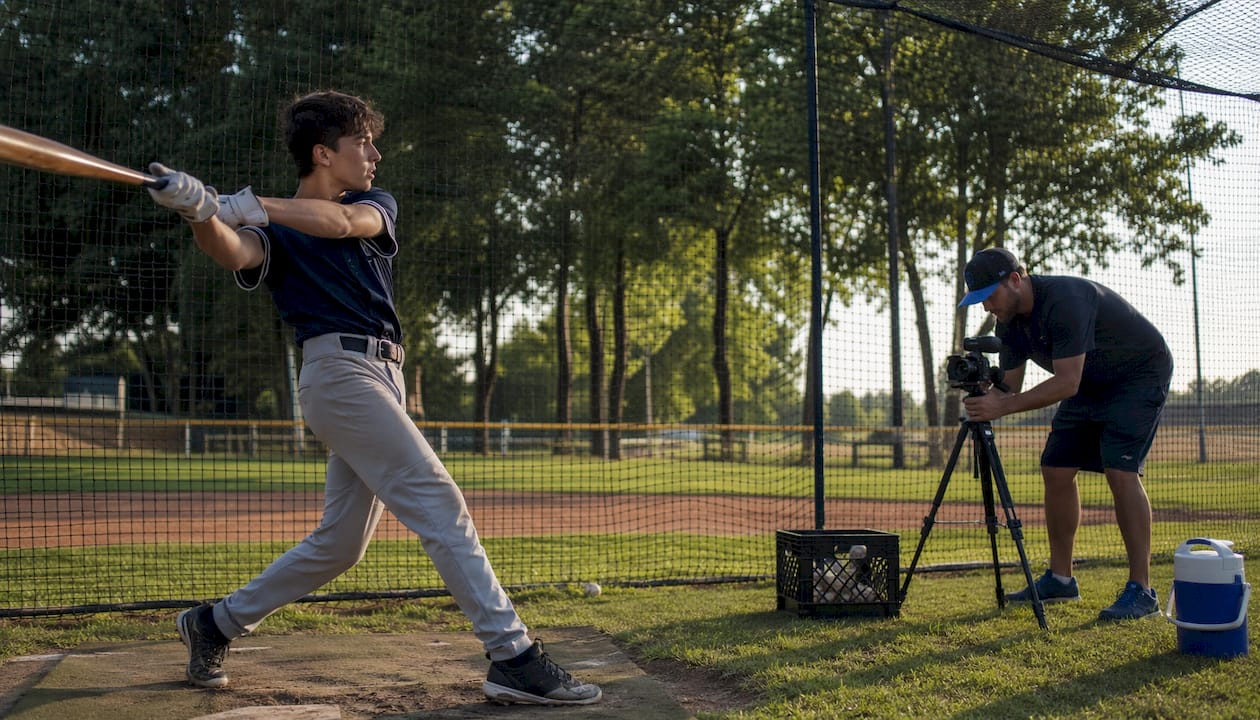
"caption": "Coach recording baseball player swing in batting cage"
},
"author": {
"url": "https://nationalscoutingbureau.com",
"name": "Nationalscoutingbureau",
"@type": "Organization"
},
"headline": "How to Use Video Analysis for Batting Mechanics",
"publisher": {
"url": "https://nationalscoutingbureau.com",
"name": "Nationalscoutingbureau",
"@type": "Organization"
},
"inLanguage": "en-US",
"description": "Discover how to use video analysis for batting mechanics to pinpoint flaws, refine your swing, and enhance performance with targeted drills.",
"datePublished": "2026-07-18T07:02:09.975Z"
},
{
"name": "How to Use Video Analysis for Batting Mechanics",
"@type": "ItemList",
"itemListElement": [
{
"item": {
"url": "https://www.catapult.com/blog/baseball-swing-analysis",
"name": "Catapult",
"@type": "Thing"
},
"@type": "ListItem",
"position": 1
},
{
"item": {
"url": "https://mindandmuscle.ai/swing-mechanics-guide",
"name": "Swing Catalyst",
"@type": "Thing"
},
"@type": "ListItem",
"position": 2
}
]
},
{
"@type": "BreadcrumbList",
"itemListElement": [
{
"item": "https://nationalscoutingbureau.com",
"name": "Nationalscoutingbureau",
"@type": "ListItem",
"position": 1
},
{
"item": "https://nationalscoutingbureau.com/use-video-analysis-batting-mechanics",
"name": "How to Use Video Analysis for Batting Mechanics",
"@type": "ListItem",
"position": 2
}
]
}
],
"@context": "https://schema.org"
}
</script>
<h1 id="how-to-use-video-analysis-for-batting-mechanics" tabindex="-1">How to Use Video Analysis for Batting Mechanics</h1>
<p><img src="https://csuxjmfbwmkxiegfpljm.supabase.co/storage/v1/object/public/blog-images/organization-34605/1784357423792_Coach-recording-baseball-player-swing-in-batting-cage.jpeg" alt="Coach recording baseball player swing in batting cage"></p>
<p>Video analysis cuts through the biggest lie in hitting: what your swing <em>feels</em> like versus what it actually <em>looks</em> like. Record your swings from the side, front, and rear, then review in slow motion to expose flaws in hip rotation, hand path, and timing that feel invisible at full speed. Combine that footage with targeted drills, and you have a feedback loop that accelerates correction faster than any amount of verbal coaching alone. Here’s how to build that system from the ground up.</p>
<p><strong>The core process in six steps:</strong></p>
<ul>
<li>Record from at least two camera angles: side view and front view as a minimum baseline</li>
<li>Use 60fps or higher to capture the swing phases your eye misses at real speed</li>
<li>Focus your review on hip rotation, hand path, stride alignment, and contact point</li>
<li>Use slow motion and frame-by-frame playback to catch subtle mechanical breakdowns</li>
<li>Pair every flaw you identify with a specific drill targeting that phase only</li>
<li>Repeat sessions consistently so you can compare footage across weeks and track real change</li>
</ul>
<h2 id="how-to-use-video-analysis-for-batting-mechanics-key-swing-elements-to-observe" tabindex="-1">How to use video analysis for batting mechanics: key swing elements to observe</h2>
<p>The baseball swing is a chain reaction. Break one link and the whole sequence loses power. When you pull up footage, you need to know exactly what you’re looking for at each phase.</p>
<p><strong>Stance and load</strong> set the table for everything that follows. Watch for a balanced, athletic setup with weight centered and the hands in a strong launch position. A hitter who loads too early or too late will be fighting timing all session.</p>
<p><strong>Hip rotation</strong> is where the real power lives. Hip mechanics drive bat speed more than any adjustment you can make to the hands, so it’s the first thing to evaluate on side-view footage. Watch for the hips firing before the hands, creating separation between the lower and upper body.</p>
<p><img src="https://csuxjmfbwmkxiegfpljm.supabase.co/storage/v1/object/public/blog-images/organization-34605/1784357414726_Side-view-of-hip-rotation-during-baseball-swing.jpeg" alt="Side view of hip rotation during baseball swing"></p>
<p><strong>Hand path and barrel control</strong> show up best on the rear view. Hands that drift away from the body before the barrel enters the zone, a flaw called casting, rob hitters of bat speed and contact quality. The front view reveals whether the front side stays closed long enough, and whether the stride is clean or drifting toward the bucket. Follow-through completeness on the side view tells you whether the hitter committed fully or quit on the swing early.</p>
<p><img src="https://csuxjmfbwmkxiegfpljm.supabase.co/storage/v1/object/public/blog-images/organization-34605/1784357418038_Rear-view-showing-hand-and-barrel-control-in-swing.jpeg" alt="Rear view showing hand and barrel control in swing"></p>
<h2 id="what-metrics-matter-most-in-swing-video-analysis" tabindex="-1">What metrics matter most in swing video analysis</h2>
<p>Modern swing analysis tools track several measurable indicators that turn footage into data you can act on.</p>
<table>
<thead>
<tr>
<th>Metric</th>
<th>What It Measures</th>
<th>Why It Matters</th>
</tr>
</thead>
<tbody>
<tr>
<td>Bat speed</td>
<td>Velocity of the barrel through the zone</td>
<td>Direct indicator of power potential and contact quality</td>
</tr>
<tr>
<td>Hip-to-shoulder separation</td>
<td>Angle between hips and shoulders at swing initiation</td>
<td>Measures torque generation; more separation means more power</td>
</tr>
<tr>
<td>Launch angle</td>
<td>Vertical angle of the ball off the bat</td>
<td>Determines ball trajectory and distance</td>
</tr>
<tr>
<td>Time to contact</td>
<td>Duration from swing start to ball contact</td>
<td>Reflects swing quickness and pitch reaction ability</td>
</tr>
<tr>
<td>Barrel path</td>
<td>Angle and direction of the bat through the hitting zone</td>
<td>Indicates swing efficiency and precision</td>
</tr>
</tbody>
</table>
<ul>
<li><strong>Bat speed</strong> is the headline number. Faster barrel velocity means harder contact and more margin for error on pitch timing.</li>
<li><strong>Hip-to-shoulder separation</strong> is the torque metric. Wide separation at swing initiation means the lower half is doing its job.</li>
<li><strong>Launch angle</strong> tells you whether the swing path matches the pitch plane.</li>
<li><strong>Time to contact</strong> exposes whether a hitter is getting beat by velocity or struggling with breaking balls.</li>
<li><strong>Barrel path</strong> shows whether the bat stays in the zone long enough to give the hitter a real window to make contact.</li>
</ul>
<h2 id="which-tools-give-you-the-best-swing-video-analysis" tabindex="-1">Which tools give you the best swing video analysis?</h2>
<p>Two platforms lead the field for serious baseball swing analysis, and they serve different needs.</p>
<table>
<thead>
<tr>
<th>Tool</th>
<th>Key Features</th>
<th>Sensor Integration</th>
<th>Ease of Use</th>
<th>Best For</th>
</tr>
</thead>
<tbody>
<tr>
<td><a href="https://www.catapult.com/blog/baseball-swing-analysis" rel="nofollow noopener noreferrer" target="_blank">Catapult</a></td>
<td>Frame-by-frame video breakdown, GPS wearables, mobile data access</td>
<td>GPS and LPS wearables, real-time movement data</td>
<td>Moderate; built for coaching staff</td>
<td>Teams and serious players needing integrated biomechanical and real-time data</td>
</tr>
<tr>
<td><a href="https://mindandmuscle.ai/swing-mechanics-guide" rel="nofollow noopener noreferrer" target="_blank">Swing Catalyst</a></td>
<td>Video plus sensor plate analysis, consolidated swing metrics</td>
<td>Force plate sensors under the batter</td>
<td>Straightforward for coaches</td>
<td>Coaches needing clean, consolidated swing data in one view</td>
</tr>
</tbody>
</table>
<p>Catapult pairs video with GPS wearables through its Vector system, capturing swing load, acceleration, and direction in near real-time. Coaches can pull data on mobile devices during live sessions, making in-game adjustments genuinely possible. Swing Catalyst takes a different approach: sensor plates embedded in the ground under the batter feed pressure and weight-transfer data directly into the video timeline, so coaches see exactly when and how the lower half fires relative to the swing on screen.</p>
<p>For teams on a tighter budget, a smartphone shooting at 60fps or higher covers the fundamentals. Set it on a tripod, perpendicular to the hitter at hip height for the side view, and you have a workable baseline before investing in sensor-integrated platforms.</p>
<p><strong>Pro Tip:</strong> <em>Record every session from the same distance and angle. Footage that’s comparable across weeks tells you far more than a single polished clip.</em></p>
<p><img src="https://csuxjmfbwmkxiegfpljm.supabase.co/storage/v1/object/public/blog-images/organization-34605/1784358115298_Infographic-illustrating-five-steps-of-video-analysis-for-batting-mechanics.jpeg" alt="Infographic illustrating five steps of video analysis for batting mechanics"></p>
<h2 id="expert-coaching-insights-on-video-driven-batting-improvement" tabindex="-1">Expert coaching insights on video-driven batting improvement</h2>
<p>Video feedback combined with verbal coaching corrects motor skill errors faster than verbal coaching alone, according to a 2019 study in the <em>Journal of Sports Science & Medicine.</em> For a movement as complex as the baseball swing, that gap is decisive.</p>
<p>Coaches who get the most from video analysis share a few consistent habits. They fix one flaw at a time, working a single high-leverage breakdown for several weeks before reassessing. They prioritize hip mechanics before touching hand adjustments, because the lower half is the primary engine. And they tailor the feedback to the athlete’s age: <a href="https://www.drivelinebaseball.com/2026/01/optimizing-bat-paths/" rel="nofollow noopener noreferrer" target="_blank">young hitters gain more</a> from correcting swing path inefficiencies than older players, whose mechanics are more ingrained.</p>
<p>Fixing casting through video-verified drills often unlocks natural improvements in other swing phases without additional coaching intervention. Mental repeatability matters too: a hitter who can reproduce the corrected movement under game pressure is the real goal, not just a clean cage session.</p>
<h2 id="how-to-run-a-video-analysis-session-step-by-step" tabindex="-1">How to run a video analysis session step by step</h2>
<ol>
<li><strong>Set up cameras before batting practice starts.</strong> Side view perpendicular to the hitter, front view from the pitcher’s perspective, and a rear view behind the plate if possible.</li>
<li><strong>Record in batches.</strong> Ten to fifteen swings against the same pitch type gives you clear patterns rather than noise.</li>
<li><strong>Review immediately after the session</strong> while the physical feel is still fresh. Pull up the side view first to check hip timing and bat path.</li>
<li><strong>Use slow motion and frame-by-frame</strong> to isolate the exact moment a flaw appears. Full-speed review misses the details that matter.</li>
<li><strong>Identify one primary flaw</strong> per session. More than one correction at a time fragments focus and slows progress.</li>
<li><strong>Assign a specific drill</strong> targeting that phase. Document the flaw and the drill so you can compare footage at the next session.</li>
</ol>
<h2 id="how-to-integrate-video-feedback-into-your-training-routine" tabindex="-1">How to integrate video feedback into your training routine</h2>
<p>Video analysis only pays off when it connects directly to what happens in the cage. After identifying a flaw, build the next two to three weeks of tee work and front-toss reps around correcting that single issue. Then re-record under the same conditions and compare. This cycle, identify, drill, reassess, is what turns a one-time film session into a <a href="https://nationalscoutingbureau.com/blog/benefits-of-verified-performance-assessments-in-baseball" target="_blank" rel="noopener">verified performance improvement</a>.</p>
<p>Keep a simple session log: date, flaw identified, drill assigned, and a one-line note on what the next video showed. Over a full season, that log becomes a mechanical history that reveals which changes stuck and which ones regressed under game pressure.</p>
<h2 id="best-practices-for-filming-batting-sessions" tabindex="-1">Best practices for filming batting sessions</h2>
<p>Good footage is the foundation. Shaky or poorly positioned video produces unreliable analysis regardless of the software you use.</p>
<ul>
<li><strong>Use a tripod every time.</strong> Even minor camera movement creates errors in angle measurement and makes frame-by-frame comparison unreliable.</li>
<li><strong>Shoot at 60fps minimum.</strong> Most modern smartphones handle this natively. At 120fps, you can study the contact frame and launch angle with real precision.</li>
<li><strong>Keep the full body in frame</strong> from the side view. Cutting off the feet or the follow-through loses critical mechanical information.</li>
<li><strong>Avoid backlighting.</strong> Position the camera so the light source is behind it, not behind the hitter.</li>
<li><strong>Mark a consistent camera position</strong> with tape or a cone so every session is filmed from the same spot.</li>
</ul>
<h2 id="common-swing-errors-video-analysis-catches" tabindex="-1">Common swing errors video analysis catches</h2>
<p>Certain flaws are nearly impossible to diagnose by feel alone but jump off the screen on video.</p>
<ul>
<li><strong>Casting:</strong> Hands drift away from the body before the barrel enters the zone. Rear view makes this undeniable.</li>
<li><strong>Lunging:</strong> Weight transfers too early, pulling the front shoulder off the ball. Front view exposes it immediately.</li>
<li><strong>Dropping hands:</strong> The barrel dips below the hands at swing initiation, creating an inefficient upward path. Side view catches it.</li>
<li><strong>Spinning off the ball:</strong> The back foot releases too early, pulling the hips through before contact. Side and rear views both reveal it.</li>
<li><strong>Head movement:</strong> The head drifts toward the pitcher during the stride, disrupting pitch tracking. Front view is the clearest angle for this.</li>
</ul>
<h2 id="how-to-interpret-video-data-and-spot-mechanical-flaws" tabindex="-1">How to interpret video data and spot mechanical flaws</h2>
<p>Reading footage well is a skill. Start with the side view and work phase by phase: load, stride, hip fire, hand path, contact, follow-through. At each checkpoint, ask whether the body is in the position that sets up the next phase correctly.</p>
<p>Frame-by-frame review at the moment of hip initiation tells you whether the lower half is leading or whether the hands are firing first. A hitter whose hands beat their hips to the ball will always be limited in power, regardless of how hard they work in the cage. On the rear view, watch the back elbow path: an elbow that flies out early signals casting before the barrel even enters the zone. Cross-reference what you see on one angle with the other angles before drawing conclusions, because some flaws look different depending on the camera position. A <a href="https://nationalscoutingbureau.com/blog/how-to-conduct-a-verified-baseball-skills-assessment" target="_blank" rel="noopener">verified baseball skills assessment</a> can add a structured framework to this process, especially for youth players still developing their mechanical baseline.</p>
<h2 id="nationalscoutingbureau-pairs-video-data-with-college-recruitment" tabindex="-1">Nationalscoutingbureau pairs video data with college recruitment</h2>
<p>If you’re using swing analysis to develop a player who’s also chasing a college roster spot, the tools above give you the mechanical picture. Nationalscoutingbureau gives you the recruitment path to go with it.</p>
<p><img src="https://csuxjmfbwmkxiegfpljm.supabase.co/storage/v1/object/public/blog-images/organization-34605/1780261783187_nationalscoutingbureau.jpg" alt="https://nationalscoutingbureau.com"></p>
<p>NSB uses FlightScope technology to generate precise performance metrics that college coaches actually trust, and pairs that data with up to 12,000 Tuition Rewards points per year at over 400 participating colleges. With 600+ college placements and more than 20 MLB draft picks in its track record, NSB connects the mechanical work you’re doing in the cage to the coaches who need to see it. If the goal is a <a href="https://nationalscoutingbureau.com" target="_blank" rel="noopener">college baseball opportunity</a>, NSB is the bridge between a polished swing and a scholarship conversation.</p>
<h2 id="key-takeaways" tabindex="-1">Key Takeaways</h2>
<p>Video analysis closes the gap between how a swing feels and what it actually looks like, making it the most direct path to faster mechanical improvement.</p>
<table>
<thead>
<tr>
<th>Point</th>
<th>Details</th>
</tr>
</thead>
<tbody>
<tr>
<td>Film from multiple angles</td>
<td>Side, front, and rear views each reveal different mechanical flaws; use at least two.</td>
</tr>
<tr>
<td>Prioritize hip mechanics</td>
<td>Hip rotation generates the majority of bat speed; fix it before adjusting hand path.</td>
</tr>
<tr>
<td>Track key metrics</td>
<td>Bat speed, launch angle, time to contact, and barrel path turn footage into measurable data.</td>
</tr>
<tr>
<td>Fix one flaw at a time</td>
<td>Isolate a single high-leverage breakdown and drill it for several weeks before reassessing.</td>
</tr>
<tr>
<td>Nationalscoutingbureau</td>
<td>NSB pairs FlightScope performance metrics with college recruitment, connecting swing development to real roster opportunities.</td>
</tr>
</tbody>
</table>
<h2 id="recommended" tabindex="-1">Recommended</h2>
<ul>
<li><a href="https://nationalscoutingbureau.com/blog/how-to-use-technology-for-player-evaluation" target="_blank" rel="noopener">NSB Scouting | The Nation’s Fastest Growing Scouting Organization</a></li>
<li><a href="https://nationalscoutingbureau.com/blog/why-bat-speed-translates-to-power-in-baseball" target="_blank" rel="noopener">NSB Scouting | The Nation’s Fastest Growing Scouting Organization</a></li>
<li><a href="https://nationalscoutingbureau.com/blog/benefits-of-verified-performance-assessments-in-baseball" target="_blank" rel="noopener">NSB Scouting | The Nation’s Fastest Growing Scouting Organization</a></li>
<li><a href="https://nationalscoutingbureau.com/blog/how-to-run-an-effective-baseball-evaluation-camp" target="_blank" rel="noopener">NSB Scouting | The Nation’s Fastest Growing Scouting Organization</a></li>
</ul>