June 15, 2026 25 views news
Youth Baseball Speed and Agility Tests: 2026 Guide
By BabyLoveGrowth.ai
<script type="application/ld+json">
{
"@type": "Article",
"image": {
"url": "https://csuxjmfbwmkxiegfpljm.supabase.co/storage/v1/object/public/blog-images/organization-34605/1781770245998_Youth-baseball-player-sprinting-during-agility-test.jpeg",
"@type": "ImageObject",
"caption": "Youth baseball player sprinting during agility test"
},
"author": {
"url": "https://nationalscoutingbureau.com",
"name": "Nationalscoutingbureau",
"@type": "Organization"
},
"@context": "http://schema.org",
"headline": "Youth Baseball Speed and Agility Tests: 2026 Guide",
"publisher": {
"url": "https://nationalscoutingbureau.com",
"name": "Nationalscoutingbureau",
"@type": "Organization"
},
"inLanguage": "en-US",
"description": "Discover the essential youth baseball speed and agility tests in our 2026 guide. Unlock player potential with objective, reliable assessments.",
"datePublished": "2026-06-18T08:10:49.199Z"
}
</script>
<h1 id="youth-baseball-speed-and-agility-tests-2026-guide" tabindex="-1">Youth Baseball Speed and Agility Tests: 2026 Guide</h1>
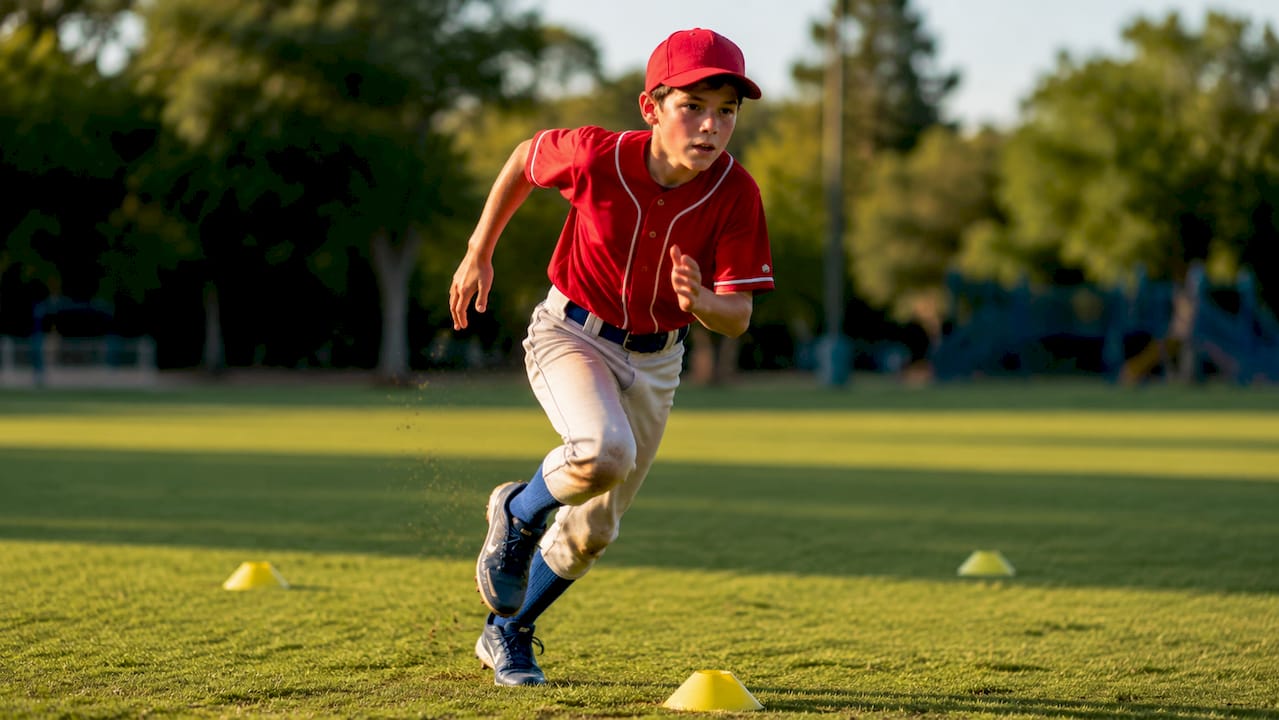
<p><img src="https://csuxjmfbwmkxiegfpljm.supabase.co/storage/v1/object/public/blog-images/organization-34605/1781770245998_Youth-baseball-player-sprinting-during-agility-test.jpeg" alt="Youth baseball player sprinting during agility test"></p>
<p>Youth baseball speed and agility tests are standardized athletic assessments that measure how fast and efficiently a player accelerates, changes direction, and reacts on the field. These tests go beyond the eye test. They use tools like electronic timing gates and the Pro Agility shuttle to produce objective data that coaches and college recruiters actually trust. Whether you are a parent tracking your 12-year-old’s development or a coach building a tryout protocol, these assessments give you a clear, numbers-backed picture of where each athlete stands.</p>
<h2 id="1-what-are-the-best-standardized-speed-tests-for-youth-baseball-players" tabindex="-1">1. What are the best standardized speed tests for youth baseball players?</h2>
<p>The 10-yard and 30-yard dash are the gold-standard sprint tests for youth baseball. Both tests measure acceleration, which is the phase of speed that matters most in a game where most sprints cover 60 to 90 feet. <a href="https://optimalpowerperformance.com/blogs/news/speed-training-for-baseball-players" rel="nofollow noopener noreferrer" target="_blank">Focusing training on acceleration phases</a> improves on-field performance and reduces injury risk compared to longer sprint work.</p>
<p><img src="https://csuxjmfbwmkxiegfpljm.supabase.co/storage/v1/object/public/blog-images/organization-34605/1781770246436_Coach-holding-stopwatch-timing-youth-sprint.jpeg" alt="Coach holding stopwatch timing youth sprint"></p>
<p><a href="https://peakprimalwellness.com/blogs/wellness/speed-agility-testing-youth-athletes" rel="nofollow noopener noreferrer" target="_blank">Electronic timing gates</a> reduce manual stopwatch error from 0.1–0.3 seconds down to 1/1,000th of a second. That level of precision matters when a tenth of a second separates a recruited player from one who gets passed over.</p>
<p>Typical 10-yard acceleration benchmarks by age group:</p>
<ul>
<li><strong>Ages 12–13:</strong> 1.85–1.95 seconds</li>
<li><strong>Ages 14–15:</strong> 1.75–1.85 seconds</li>
<li><strong>Ages 16–18:</strong> 1.55–1.72 seconds (elite performers near 1.72 seconds)</li>
</ul>
<p>The 60-yard dash gets attention at showcases, but shorter sprint distances better reflect in-game speed demands. Baseball is a game of explosive bursts, not long-distance track events. Train and test accordingly.</p>
<p><strong>Pro Tip:</strong> <em>Always use electronic timing gates for official assessments. Human eye timing introduces errors large enough to misclassify an athlete’s true speed tier.</em></p>
<h2 id="2-how-do-agility-tests-like-the-5-10-5-shuttle-evaluate-baseball-specific-athleticism" tabindex="-1">2. How do agility tests like the 5-10-5 shuttle evaluate baseball-specific athleticism?</h2>
<p>The 5-10-5 shuttle, also called the Pro Agility test, is the most widely used agility assessment in baseball scouting. The athlete starts at a midpoint, sprints 5 yards to one side, cuts back 10 yards to the opposite side, then finishes with a 5-yard sprint through the start. The whole run covers 20 yards of lateral movement with two hard direction changes.</p>
<p>The 5-10-5 shuttle measures deceleration, change of direction, and lateral agility. Those three qualities directly translate to range in the outfield, first-step reactions at shortstop, and baserunning instincts. High school athletes should target times under 4.8 seconds to be competitive at the next level.</p>
<p>What separates a good 5-10-5 time from a great one is not just leg speed. <a href="https://exercisedaily.com/baseball-agility-drills-for-youth/" rel="nofollow noopener noreferrer" target="_blank">Agility is a cognitive skill</a> that benefits from reaction drills responding to visual cues rather than solely memorized cone patterns. A player who has trained with reactive signals will cut faster because the brain fires before the body hesitates.</p>
<p>Key metrics the 5-10-5 shuttle reveals:</p>
<ul>
<li><strong>Deceleration control:</strong> Can the athlete brake hard without losing balance?</li>
<li><strong>Hip rotation speed:</strong> How quickly does the player redirect force through the cut?</li>
<li><strong>Lateral burst:</strong> Does the athlete accelerate out of the cut or drift?</li>
<li><strong>Cognitive reaction:</strong> Does the player anticipate or react to the direction signal?</li>
</ul>
<h2 id="3-which-baseball-specific-drills-complement-speed-and-agility-testing-for-youth-players" tabindex="-1">3. Which baseball-specific drills complement speed and agility testing for youth players?</h2>
<p>Testing tells you where a player stands. Drills move the needle. The best baseball agility drills target the same movement patterns the tests measure, so every practice session builds directly toward better assessment scores and better game performance.</p>
<ol>
<li><strong>Ladder drills:</strong> Quick-feet ladder patterns build foot speed and neuromuscular coordination. Run the in-in-out-out pattern and the lateral shuffle to train the same hip mechanics used in the 5-10-5 shuttle.</li>
<li><strong>Cone sprints:</strong> Set cones at 5, 10, and 20 yards. Sprint to each cone, decelerate, and return. This trains the stop-and-go rhythm of baserunning and outfield reads.</li>
<li><strong>Sprint and backpedal combos:</strong> Sprint 10 yards, stop, backpedal 5 yards, then drive forward again. This drill builds the deceleration strength that protects hamstrings and improves first-step quickness.</li>
<li><strong>Reactive agility drills:</strong> A coach or partner holds up a colored cone or flashes a hand signal. The athlete reacts and sprints in the indicated direction. Visual processing and reaction time development improve instinctive responsiveness to unpredictable game scenarios.</li>
<li><strong>Base-path acceleration runs:</strong> Sprint from home to first at full effort, focusing on the first 10 yards out of the box. This drill directly trains the explosive start that separates safe from out on a ground ball.</li>
</ol>
<p>For players under 14, <a href="https://battingleadoff.com/baseball-speed-and-agility-drills/" rel="nofollow noopener noreferrer" target="_blank">training recommendations</a> cap sessions at 20–25 minutes and limit speed work to 2–3 sessions per week. That structure keeps the focus on form and fun, which drives long-term athletic development better than grinding volume.</p>
<p><strong>Pro Tip:</strong> <em>Rotate reactive agility drills into at least one session per week. Cone patterns alone build memorized movement, not true game-speed instincts.</em></p>
<h2 id="4-how-to-interpret-test-results-and-use-them-for-training-and-recruitment" tabindex="-1">4. How to interpret test results and use them for training and recruitment</h2>
<p>Raw numbers mean nothing without context. A 10-yard dash time of 1.80 seconds is excellent for a 13-year-old and average for a 16-year-old. Always compare results to age-matched benchmarks, not to older players or professional standards.</p>
<p>Home-to-first benchmarks give a useful real-world frame: 12U players average 8.8–9.2 seconds, high school players average 7.2–7.6 seconds, and collegiate targets sit at 6.8–7.1 seconds. Left-handed hitters have a natural advantage due to their starting position in the batter’s box. Coaches should account for handedness when comparing times.</p>
<p><a href="https://mdpi.com/2076-3417/16/3/1268" rel="nofollow noopener noreferrer" target="_blank">Sprint improvements must exceed 0.094 seconds</a> over 20 meters to confirm real progress beyond normal biological variance. That threshold helps coaches separate genuine training gains from day-to-day fluctuation. If a player drops 0.05 seconds, that is encouraging but not statistically confirmed improvement.</p>
<table>
<thead>
<tr>
<th>Metric</th>
<th>Manual Timing</th>
<th>Electronic Timing</th>
</tr>
</thead>
<tbody>
<tr>
<td>Accuracy</td>
<td>±0.1–0.3 seconds</td>
<td>±0.001 seconds</td>
</tr>
<tr>
<td>Recruitment value</td>
<td>Low</td>
<td>High</td>
</tr>
<tr>
<td>Reproducibility</td>
<td>Inconsistent</td>
<td>Consistent</td>
</tr>
<tr>
<td>Cost</td>
<td>Free</td>
<td>Moderate to high</td>
</tr>
<tr>
<td>Best use</td>
<td>Practice feedback</td>
<td>Official assessment</td>
</tr>
</tbody>
</table>
<p>Overtraining sprint volume year-round reduces speed and increases injury risk. Speed training should be waved and peaked before the season to build tissue tolerance and recovery. A player who peaks at the right time runs faster at tryouts and stays healthier through the summer.</p>
<h2 id="5-what-equipment-and-technology-are-recommended-for-accurate-assessments-in-2026" tabindex="-1">5. What equipment and technology are recommended for accurate assessments in 2026?</h2>
<p>Modern youth baseball fitness assessments rely on more than a stopwatch and a cone. The right equipment produces data that coaches trust and recruiters act on.</p>
<p>Electronic timing gates are the baseline requirement for any serious assessment. Brands like Brower Timing and Freelap produce gate systems used at the high school and collegiate levels. These systems capture split times at multiple distances, giving coaches a full picture of acceleration and top-end speed in a single run.</p>
<p>Reactive light and sound sensor systems take agility testing further. These tools flash signals that athletes must respond to, measuring both physical speed and cognitive reaction time. <a href="https://repsfootball.com/product/performance-testing-event/" rel="nofollow noopener noreferrer" target="_blank">Modern performance testing</a> combines speed, agility, cognition, and reaction metrics into a single player profile, with digital reports typically available within 48 hours.</p>
<p>Key equipment categories for youth baseball speed and agility assessments:</p>
<ul>
<li><strong>Electronic timing gates:</strong> Brower Timing, Freelap, and similar systems for sprint precision</li>
<li><strong>Reactive agility sensors:</strong> Light-based or sound-based systems that test cognitive response speed</li>
<li><strong>Digital reporting platforms:</strong> Software that stores results, tracks progress over time, and generates shareable reports for recruiters</li>
<li><strong>Agility cones and ladders:</strong> Low-cost tools for drill-based training between formal assessments</li>
</ul>
<p>Budget-conscious programs can start with electronic gates and standard cones. Reactive sensor systems add meaningful cognitive data and are worth the investment for players pursuing <a href="https://nationalscoutingbureau.com/blog/what-is-verified-player-assessment-for-student-athletes" target="_blank" rel="noopener">verified player assessment</a> at the high school level and beyond. The <a href="https://nationalscoutingbureau.com/blog/technology-tools-for-youth-athlete-assessment-in-2026" target="_blank" rel="noopener">technology tools available in 2026</a> make it easier than ever to build a complete athletic profile without a college-level budget.</p>
<h2 id="key-takeaways" tabindex="-1">Key takeaways</h2>
<p>The most effective youth baseball speed and agility tests combine electronic timing for linear sprints with the 5-10-5 shuttle and reactive agility drills to measure the full range of baseball-specific athleticism.</p>
<table>
<thead>
<tr>
<th>Point</th>
<th>Details</th>
</tr>
</thead>
<tbody>
<tr>
<td>Use electronic timing</td>
<td>Manual stopwatches introduce errors large enough to misclassify an athlete’s speed tier.</td>
</tr>
<tr>
<td>Test the right distances</td>
<td>The 10-yard and 30-yard dash reflect in-game speed demands better than the 60-yard dash.</td>
</tr>
<tr>
<td>Track meaningful improvement</td>
<td>Sprint gains must exceed 0.094 seconds over 20 meters to confirm real training progress.</td>
</tr>
<tr>
<td>Match benchmarks to age</td>
<td>Compare results to age-matched standards, not older players or professional norms.</td>
</tr>
<tr>
<td>Include reactive agility work</td>
<td>Visual cue drills build instinctive responsiveness that cone patterns alone cannot develop.</td>
</tr>
</tbody>
</table>
<h2 id="what-i-have-learned-from-years-of-watching-young-athletes-get-tested" tabindex="-1">What I have learned from years of watching young athletes get tested</h2>
<p>The biggest mistake I see coaches and parents make is treating the stopwatch as the whole story. A kid who runs a 1.78-second 10-yard dash but freezes on first-step reads is not faster than a 1.82-second athlete who fires out of the box on instinct. Speed tests alone are insufficient. <a href="https://www.beachcitybaseball.com/post/enhancing-youth-baseball-performance-through-speed-agility-and-coordination-training" rel="nofollow noopener noreferrer" target="_blank">Baseball-specific movement and first-step explosiveness</a> are the real differentiators in talent evaluation.</p>
<p>The other thing I push back on hard is the obsession with year-round sprint volume. I have watched talented 14-year-olds grind through conditioning programs that would challenge a college player, and by spring they are slower, not faster. Overzealous conditioning without phased sprint volume harms player speed and raises injury risk. Structure matters more than effort.</p>
<p>What actually works is simple. Test consistently, compare to age-matched benchmarks, train the movements the tests measure, and keep sessions short and fun for younger players. The athletes who improve the most are not the ones who work the hardest in october. They are the ones who show up to spring tryouts having peaked at the right time, with fresh legs and sharp instincts.</p>
<blockquote>
<p><em>— Coach</em></p>
</blockquote>
<h2 id="how-nationalscoutingbureau-supports-your-athletes-speed-and-agility-development" tabindex="-1">How Nationalscoutingbureau supports your athlete’s speed and agility development</h2>
<p>Nationalscoutingbureau delivers verified speed and agility assessments built on electronic timing and sport-specific movement testing, the same standards college coaches expect. Every athlete receives a digital performance report that benchmarks their results against age-matched peers and position-specific targets.</p>
<p><img src="https://csuxjmfbwmkxiegfpljm.supabase.co/storage/v1/object/public/blog-images/organization-34605/1780261783187_nationalscoutingbureau.jpg" alt="https://nationalscoutingbureau.com"></p>
<p>Parents and coaches who want objective data driving their player’s development and recruitment strategy can get started with <a href="https://nationalscoutingbureau.com" target="_blank" rel="noopener">NSB’s scouting services</a> today. With 600+ college placements and more than 20 MLB draft picks, Nationalscoutingbureau knows what it takes to get your athlete <a href="https://nationalscoutingbureau.com/blog/next-level-baseball-skills-safety-and-recruiting" target="_blank" rel="noopener">seen at the next level</a>.</p>
<h2 id="faq" tabindex="-1">FAQ</h2>
<h3 id="what-is-the-most-important-speed-test-for-youth-baseball-players" tabindex="-1">What is the most important speed test for youth baseball players?</h3>
<p>The 10-yard dash is the most important speed test for youth baseball because it measures explosive acceleration, which drives nearly every in-game sprint. Electronic timing gates provide the precision needed for results that carry weight in recruitment.</p>
<h3 id="how-often-should-youth-baseball-players-be-tested-for-speed-and-agility" tabindex="-1">How often should youth baseball players be tested for speed and agility?</h3>
<p>Players should be formally tested two to three times per year, ideally before the season, at midseason, and after the offseason training block. Consistent testing intervals make it possible to track genuine progress and adjust training focus.</p>
<h3 id="what-is-a-good-5-10-5-shuttle-time-for-a-high-school-baseball-player" tabindex="-1">What is a good 5-10-5 shuttle time for a high school baseball player?</h3>
<p>High school baseball players should target a 5-10-5 shuttle time under 4.8 seconds to be competitive at the next level. Times below 4.5 seconds are considered elite for position players.</p>
<h3 id="can-parents-run-these-tests-without-professional-equipment" tabindex="-1">Can parents run these tests without professional equipment?</h3>
<p>Parents can run cone-based agility drills and timed sprints for practice feedback, but electronic timing gates are required for results that recruiters and coaches trust. Manual stopwatch times carry too much error for official assessments.</p>
<h3 id="at-what-age-should-youth-players-start-formal-speed-and-agility-testing" tabindex="-1">At what age should youth players start formal speed and agility testing?</h3>
<p>Formal testing is appropriate starting around age 12, when athletes can follow instructions consistently and handle structured feedback. Under-12 players benefit more from movement-based play and coordination development than from timed assessments.</p>
<h2 id="recommended" tabindex="-1">Recommended</h2>
<ul>
<li><a href="https://nationalscoutingbureau.com/blog/role-of-biomechanics-in-youth-sports-2026-guide" target="_blank" rel="noopener">NSB Scouting | The Nation’s Fastest Growing Scouting Organization</a></li>
<li><a href="https://nationalscoutingbureau.com/blog/technology-tools-for-youth-athlete-assessment-in-2026" target="_blank" rel="noopener">NSB Scouting | The Nation’s Fastest Growing Scouting Organization</a></li>
<li><a href="https://nationalscoutingbureau.com/blog/how-to-conduct-a-verified-baseball-skills-assessment" target="_blank" rel="noopener">NSB Scouting | The Nation’s Fastest Growing Scouting Organization</a></li>
<li><a href="https://nationalscoutingbureau.com/blog/next-level-baseball-skills-safety-and-recruiting" target="_blank" rel="noopener">NSB Scouting | The Nation’s Fastest Growing Scouting Organization</a></li>
</ul>